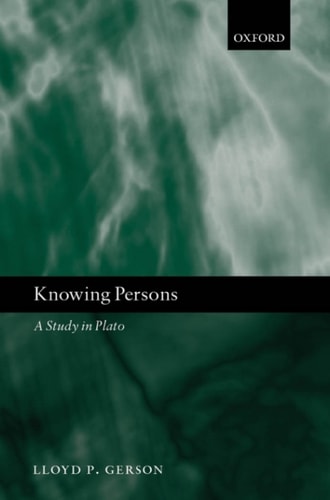
Knowing Persons: A Study in Plato
0
0
As an Amazon Associate and affiliate partner, Menrva Books earns from qualifying purchases. Learn more
Author Description
Knowing Persons is an original study of Plato's account of personhood. For Plato, embodied persons are images of a disembodied ideal. The ideal person is a knower. Hence, the lives of embodied persons need to be understood according to Plato's metaphysics of imagery. For Gerson, Plato's account of embodied personhood is not accurately conflated with Cartesian dualism. Plato's dualism is more appropriately seen in the contrast between the ideal disembodied person and the embodied one than in the contrast between mind or soul and body. This study argues that Plato's analysis of personhood is intended to cohere with his two-world metaphysics as well as a radical separation of knowledge and belief. Gerson demonstrates that Plato's account of persons plays a key role not just in his theory of mind, but in his theory of knowledge, his metaphysics, and his ethics. A proper understanding of Plato's account of persons must therefore place it in the context of his doctrines in these areas. Knowing Persons fills a significant gap by showing the way to such an understanding.
Menrva's Summary
THE THESIS
This study investigates the core question of how Plato defines personhood within the framework of his broader metaphysical and epistemological commitments. Lloyd P. Gerson, a scholar of ancient philosophy, utilizes a rigorous analysis of Platonic dialogues to argue that embodied persons are best understood as images of a disembodied ideal. He contends that Plato's dualism is fundamentally distinct from Cartesian models, focusing instead on the relationship between the ideal knower and the embodied subject. By integrating Plato's theories of mind, knowledge, and ethics, Gerson provides a cohesive interpretation of the Platonic person.
THE SCOPE MAP
What You Will Find
- An analysis of Plato's two-world metaphysics as it pertains to human identity
- A distinction between the ideal disembodied person and the embodied subject
- An examination of the separation between knowledge and belief in Platonic thought
- A synthesis of Plato's theories of mind, ethics, and metaphysics
Scope Limits
- The text does not provide a general introduction to Plato's life or historical context
- The study does not address post-Platonic interpretations or the influence of later Neoplatonism
THE AUTHORITY PERSPECTIVE
Scholars and students of ancient philosophy frequently cite this work as a significant contribution to the understanding of Platonic anthropology. Readers often note the academic density of the prose, which requires a strong familiarity with Plato's primary texts to fully grasp the author's arguments.
Page Count:
318
Publication Date:
2006-01-01
Publisher:
Clarendon Press
ISBN-10:
0191531537
ISBN-13:
9780191531538
Philosophy
Persons
Platonism
Ethics
History & Surveys
Epistemology
Metaphysics
Community Tags
Similar Books