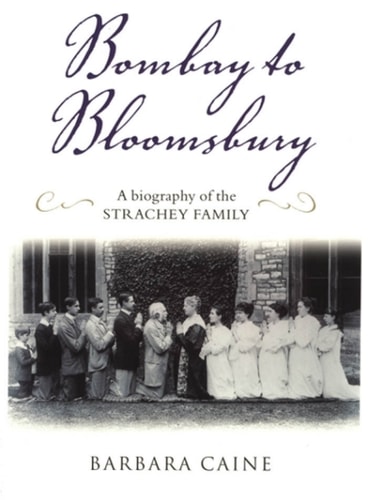
Bombay to Bloomsbury: A Biography of the Strachey Family
0
0
As an Amazon Associate and affiliate partner, Menrva Books earns from qualifying purchases. Learn more
Author Description
The Stracheys were an exceptionally intelligent and unusual family, prominent in imperial administration, science, and feminism in the nineteenth century, and in the suffrage movement, women's education, and the bringing of new approaches to sexuality in the twentieth century. Bombay to Bloomsbury examines the lives of Lytton Strachey, a well-known member of the Bloomsbury set, his nine siblings, and his parents. Richard Strachey worked in India, marrying Jane, the daughter of the Indian Chief Justice, in 1859. A successful imperial couple, they were progressive, following the ideas of Auguste Comte and J. S. Mill, and the teachings of science. Their ten children were born over a period of 27 years and reflect the development and changes in a Victorian society moving to modernity. The richness of their letters provides a fascinating picture of a large, complex, and diverse family where attitudes to the family name, gender tensions, differing views on sexuality, ideas on modernity, and varying degrees of support for feminism all played a part. Dick Strachey, the eldest son, had an unsuccessful military career in India but a loving marriage, whereas Oliver announced to horrified parents that he wished to learn the piano and give music lessons, eventually finding success as a code-breaker in both world wars. Elinor, married to a man of wealth and position, devoted her life exclusively to family and social life, whilst Ralph, Chief Surveyor in India, married a woman who suffered emotional and nervous collapses and was unable to manage a family. Pippa, a full-time suffrage organizer and, in all but name, head of the family, combined the Victorian devoted single daughter with the twentieth-century independent career woman, and James, a homosexual in adolescence, married Alix, one of the Bloomsbury cropheads who embraced sexual experimentation, psychoanalysis, and new patterns of domestic life. The remaining children, including Lytton, all had lives no less absorbing, and
Menrva's Summary
THE THESIS
This work investigates how the Strachey family served as a microcosm for the transition of British society from Victorian imperial values to twentieth-century modernity. Barbara Caine, a historian specializing in gender and biography, utilizes extensive family correspondence and archival records to trace the lives of Richard and Jane Strachey and their ten children. The book argues that the family's internal dynamics, ranging from imperial administration to early feminist activism and psychoanalytic exploration, mirror the broader cultural shifts occurring in Britain across two centuries.
THE SCOPE MAP
What You Will Find
- Detailed biographical accounts of all ten Strachey siblings and their parents.
- Analysis of the influence of Auguste Comte and J. S. Mill on the family's intellectual development.
- Examination of gender roles, suffrage activism, and evolving attitudes toward sexuality within the family unit.
Scope Limits
- The text focuses primarily on the internal family dynamics and personal development rather than providing a comprehensive political history of the British Empire.
THE AUTHORITY PERSPECTIVE
Historians and biographers frequently cite this work as a meticulous study of the intersection between private family life and public intellectual history. Scholars note the impressive depth of the research, particularly in how Caine synthesizes the vast collection of family letters to illustrate complex social transitions.
Page Count:
512
Publication Date:
2006-01-01
Publisher:
Oxford University Press
ISBN-10:
0191530522
ISBN-13:
9780191530524
History
Biography
Social History
British History
Bloomsbury Group
Victorian Era
Mathematics Statistics
Great Britain
Family history
British
Community Tags
Other Editions(2)

Similar Books
Reader Comments
Share Your Thoughts
No comments yet. Be the first to share your thoughts!