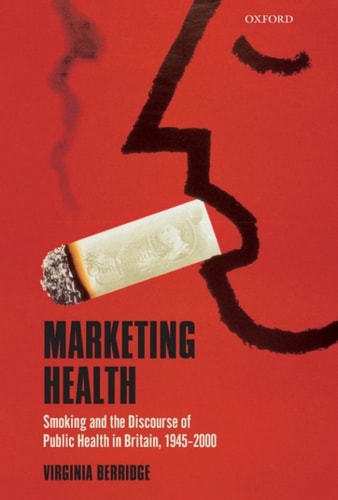
Marketing Health: Smoking and the Discourse of Public Health in Britain, 1945-2000
0
0
As an Amazon Associate and affiliate partner, Menrva Books earns from qualifying purchases. Learn more
Author Description
The post war history of public health and the role of smoking within that history epitomises the tensions which surround taking health to the public. Public health history has largely concentrated on the nineteenth century sanitary period or on the years before the Second World War, often focussing on the environmental advances, or on the professional and occupational history of public health as an activity. This book has a different focus: it deals with the change in the outlook of public health post war. From a focus on services, vaccination, and dealing with health issues at the local level, public health had developed new discourse. Centring on chronic disease, it became concerned with the concept of 'risk' and targeted individual behaviour. The mass media and centralised campaigning directed at the whole population replaced local campaigns, and politicians changed their mind about speaking directly to the public on health matters. Their early worries about the 'nanny state' gave place to a desire to inculcate new norms of behaviour, and it was debated how change was to be achieved. Identifying debates between those believing in 'systematic gradualism' and those who advocated a more coercive approach, Virginia Berridge uses smoking as a model. Such debates brought into play tensions over the relationships between public health and industrial interests. Health campaigning by new style pressure groups like ASH, which were part state funded, was an important motive force behind the change. In the 1980s and 1990s, public health changed again. Passive smoking and HIV/AIDS brought environmental concerns back into public health, which had disappeared after the 1950s. The 'rise of addiction' for smoking demonstrated the power of pharmaceutical interests to define a new 'pharmaceutical public health' in which treatment and 'magic bullets' were also tactics for prevention. In the early 21st century, public health was play to complex tensions and conflicting impetuses.
Menrva's Summary
THE THESIS
This book investigates how the post-war shift in public health discourse transformed from a focus on local services to a centralized, behavior-based model centered on the concept of risk. Virginia Berridge, a professor of history and health policy, utilizes the specific case of smoking in Britain from 1945 to 2000 to analyze these systemic changes. She examines the evolving relationship between state-funded pressure groups, industrial interests, and the political desire to influence individual behavior through mass media campaigns.
THE SCOPE MAP
What You Will Find
- Analysis of the transition from environmental public health to individual risk management.
- Examination of the role of pressure groups like ASH in shaping health policy.
- Investigation into the emergence of 'pharmaceutical public health' and the influence of addiction discourse.
Scope Limits
- The text does not provide a comprehensive history of all public health initiatives, focusing primarily on the smoking debate as a representative model.
- It does not extend its analysis beyond the early 21st century.
THE AUTHORITY PERSPECTIVE
Experts recognize this work as a foundational text for understanding the evolution of modern British health policy and the political economy of public health. Readers frequently note the academic density of the prose and the author's meticulous use of historical archives to support her arguments.
Page Count:
260
Publication Date:
2007-01-01
Publisher:
Oxford University Press
ISBN-10:
0191531979
ISBN-13:
9780191531972
History
European History
Sociology
Medicine
Public Health
British History
Community Tags
Similar Books