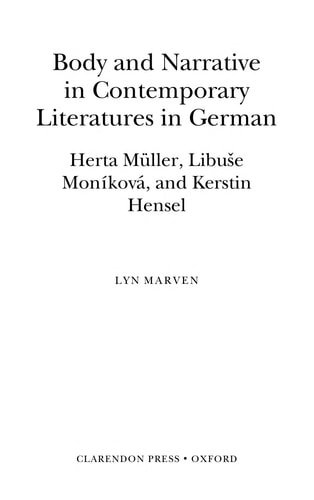
Body and Narrative in Contemporary Literatures in German: Herta Müller, Libuše Moníková, and Kerstin Hensel
0
0
As an Amazon Associate and affiliate partner, Menrva Books earns from qualifying purchases. Learn more
Author Description
This book examines the relationship between representations of the body and narrative strategies in the work of three contemporary women writers from the former Eastern Bloc countries: Herta Müller, an ethnic German from Romania; Libuše Moníková, who emigrated from Czechoslovakia to West Germany and chose to write in German; and Kerstin Hensel, from the GDR. Marven shows how the content and form of their works are interlinked, and how these challenge the hegemonic discourses within repressive socialist regimes. The introduction contextualizes the writers' socially, culturally, and historically, and outlines the theoretical basis of the approach, drawing on psychoanalysis, performativity theory, and feminist critical theory. Chapters on the individual authors offer new interpretations of the writers' works, focusing on the structures of trauma (in Müller's work), hysteria (in Moníková's) and the grotesque (in Hensel's). The images of the body analysed in the first half of each chapter show the effects of violence; challenge the understanding of the body as natural or authentic; and raise questions about identity and gender. The analysis in the second half of each chapter covers a range of formal features, from the fantastic and collage, through parody and intertextuality, to irony, plot, and story telling. The book also traces developments in the work of all three authors, taking account of the historical changes in the Eastern Bloc countries since 1989. Body and Narrative in Contemporary Literatures in German will be valuable for anyone researching contemporary German literatures, as well as those interested in feminist theory, minority literatures, and trauma.
Menrva's Summary
THE THESIS
This book investigates how representations of the human body function as narrative devices to challenge hegemonic discourses within the repressive socialist regimes of the former Eastern Bloc. Lyn L. Marven, a scholar of contemporary German literature, utilizes a theoretical framework grounded in psychoanalysis, performativity theory, and feminist criticism to analyze the works of Herta Müller, Libuše Moníková, and Kerstin Hensel. By examining the intersection of bodily imagery and formal narrative structure, Marven argues that these authors utilize specific aesthetic strategies to articulate the effects of political trauma and state-imposed violence.
THE SCOPE MAP
What You Will Find
- Comparative analysis of Herta Müller, Libuše Moníková, and Kerstin Hensel.
- Theoretical application of psychoanalysis, performativity, and feminist critical theory.
- Examination of literary techniques including collage, parody, intertextuality, and the grotesque.
- Historical context regarding the Eastern Bloc and post-1989 developments.
Scope Limits
- The study is restricted to the works of these three specific authors and does not provide a comprehensive survey of all contemporary German literature.
- The analysis focuses primarily on the intersection of body politics and narrative form rather than exhaustive biographical accounts.
THE AUTHORITY PERSPECTIVE
Scholars and students of German studies identify this work as a rigorous contribution to the understanding of post-socialist literature and gender theory. Experts frequently note the academic density of the prose and its utility for those researching the intersection of trauma studies and narrative form.
Page Count:
294
Publication Date:
2005-01-01
Publisher:
Clarendon Press
ISBN-10:
0191535141
ISBN-13:
9780191535147
Feminist Theory
English & College Success
English
German
European History
Literary Criticism