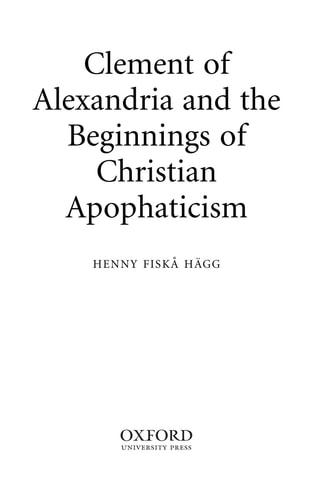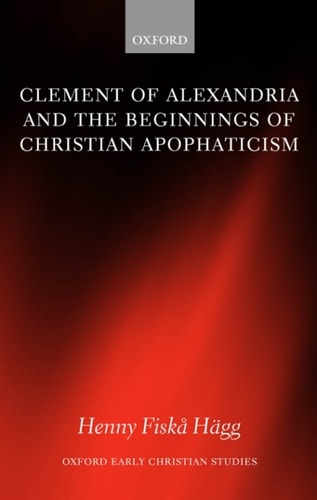
Clement of Alexandria and the Beginnings of Christian Apophaticism
0
0
As an Amazon Associate and affiliate partner, Menrva Books earns from qualifying purchases. Learn more
Author Description
Can humans know God? Can created beings approach the Uncreated? The concept of God and questions about our ability to know him are central to this book. Eastern Orthodox theology distinguishes between knowing God as he is (his divine essence) and as he presents himself (through his energies), and thus it both negates and affirms the basic question: man cannot know God in his essence, but may know him through his energies. Henny Fiska Hagg investigates this earliest stage of Christian negative (apophatic) theology, as well as the beginnings of the distinction between essence and energies, focusing on Clement of Alexandria in the late second century. Clement's theological, social, religious, and philosophical milieu is also considered, as is his indebtedness to Middle Platonism and its concept of God.
Menrva's Summary
THE THESIS
This work investigates the origins of Christian apophatic theology by examining the extent to which Clement of Alexandria established the conceptual framework for distinguishing between the divine essence and divine energies. Henny Fiska Hägg, a scholar of early Christian thought, utilizes a rigorous historical and philosophical methodology to analyze Clement's writings within the context of late second-century intellectual life. By situating Clement's work alongside Middle Platonist influences, the author argues that these early theological developments provided the foundation for later Eastern Orthodox distinctions regarding the human capacity to know God.
THE SCOPE MAP
What You Will Find
- Analysis of Clement of Alexandria's theological and philosophical corpus
- Examination of the influence of Middle Platonism on early Christian thought
- Investigation into the historical roots of the essence-energies distinction
- Contextual study of the religious and social milieu of the late second century
Scope Limits
- Does not provide a comprehensive history of all apophatic traditions
- Focuses primarily on the specific contributions of Clement rather than later Byzantine developments
THE AUTHORITY PERSPECTIVE
Scholars and theologians recognize this text as a specialized contribution to the study of early Christian philosophy and the development of negative theology. Readers frequently note the academic density of the prose, which is intended for those with a background in patristic studies or historical theology.
Page Count:
336
Publication Date:
2006-01-01
Publisher:
OUP Oxford
ISBN-10:
0191537101
ISBN-13:
9780191537103
Philosophy
History
Religion
Apophatic Theology
God knowableness
Christian Theology
Patristics