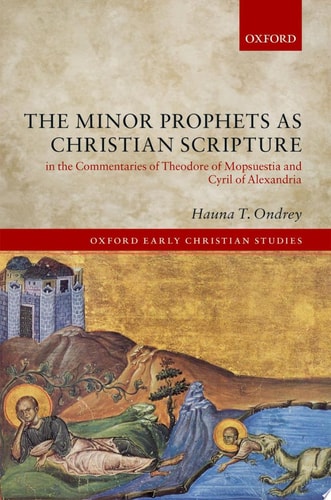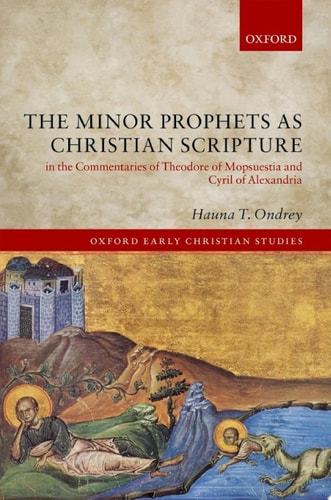
The Minor Prophets as Christian Scripture in the Commentaries of Theodore of Mopsuestia and Cyril of Alexandria
0
0
As an Amazon Associate and affiliate partner, Menrva Books earns from qualifying purchases. Learn more
Author Description
This work compares the Minor Prophets commentaries of Theodore of Mopsuestia and Cyril of Alexandria, isolating the role each interpreter assigns the Twelve Prophets in their ministry to Old Testament Israel and the texts of the Twelve as Christian scripture. Hauna T. Ondrey argues that Theodore does acknowledge christological prophecies, as distinct from both retrospective accommodation and typology. A careful reading of Cyril's Commentary on the Twelve limits the prospective christological revelation he ascribes to the prophets and reveals the positive role he grants the Mosaic law prior to Christ's advent. Exploring secondly the Christian significance Theodore and Cyril assign to Israel's exile and restoration reveals that Theodore's reading of the Twelve Prophets, while not attempting to be christocentric, is nevertheless self-consciously Christian. Cyril, unsurprisingly, offers a robust Christian reading of the Twelve, yet this too must be expanded by his focus on the church and concern to equip the church through the ethical paideusis provided by the plain sense of the prophetic text. Revised descriptions of each interpreter lead to the claim that a recent tendency to distinguish the Old Testament interpretation of Theodore (negatively) and Cyril (positively) on the basis of their "christocentrism" obscures more than it clarifies and polarizes no less than earlier accounts of Antiochene/Alexandrian exegesis. The conclusion argues against replacing old dichotomies with new and advocates rather for an approach that takes seriously Theodore's positive account of the unity and telos of the divine economy and the full range of Cyril's interpretation.
Menrva's Summary
THE THESIS
This work investigates how the commentaries of Theodore of Mopsuestia and Cyril of Alexandria interpret the Minor Prophets as Christian scripture, challenging the traditional binary opposition between their respective exegetical methods. Hauna T. Ondrey, a scholar of early Christian history, utilizes a comparative analysis of these two figures to argue that the standard distinction between Theodore's perceived lack of christocentrism and Cyril's robust christocentrism is an oversimplification. By examining their specific treatments of prophecy, the Mosaic law, and the themes of exile and restoration, the author demonstrates that both interpreters maintain a self-consciously Christian framework that defies simplistic categorization.
THE SCOPE MAP
What You Will Find
- Comparative analysis of Theodore of Mopsuestia’s and Cyril of Alexandria’s commentaries on the Twelve Prophets.
- Examination of christological prophecy, typology, and the role of the Mosaic law in early Christian exegesis.
- Investigation into the theological significance of Israel’s exile and restoration within the divine economy.
Scope Limits
- The study focuses specifically on the Minor Prophets and does not provide a comprehensive survey of the entire corpus of either author.
- The analysis is restricted to the specific exegetical methodologies of the Antiochene and Alexandrian schools as represented by these two figures.
THE AUTHORITY PERSPECTIVE
Scholars in the field of patristics and biblical studies recognize this work as a nuanced contribution to the ongoing debate regarding the Antiochene and Alexandrian schools of interpretation. Readers frequently note the academic density of the prose and the author's meticulous attention to the primary texts.
Page Count:
288
Publication Date:
2018-01-01
Publisher:
OUP Oxford
ISBN-10:
0192559451
ISBN-13:
9780192559456
Religion
Patristics
Christian Theology
History of Exegesis