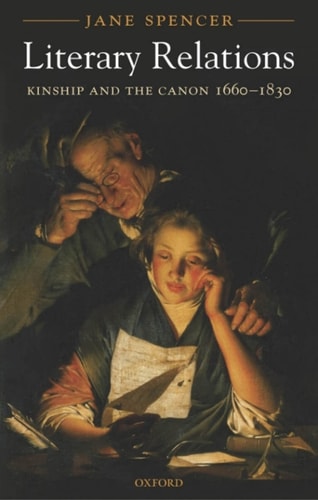
Literary Relations: Kinship and the Canon 1660-1830
0
0
As an Amazon Associate and affiliate partner, Menrva Books earns from qualifying purchases. Learn more
Author Description
Literary Relations argues that kinship relations between writers, both literal and figurative, played a central part in the creation of a national tradition of English literature. Through studies of writing relationships, including those between William and Dorothy Wordsworth, Henry and Sarah Fielding, Frances and Richard Brinsley Sheridan, and Mary Wollstonecraft and Mary Shelley, it shows that kinship between writers played a significant role not just in individual lives but in the formation of generic traditions. As writers looked back to founding fathers, and hoped to have writing sons, the literary tradition was modelled on the patriarchal family, imagined in tropes of genealogy and inheritance. This marginalized but did not exclude women, and the study ranges from the work of Dryden, with its emphasis on literature as patrilineal inheritance, to the reception of Austen, which shows uneven but significant progress towards understanding the woman writer as an inheriting daughter and generative mother.
Menrva's Summary
THE THESIS
This book investigates how kinship, both literal and figurative, functioned as a primary mechanism in the construction of the English literary canon between 1660 and 1830. Jane Spencer, a scholar of eighteenth-century literature, utilizes a historical and critical framework to examine how familial metaphors of genealogy and inheritance shaped the development of literary traditions. By analyzing the professional and personal interactions of writers such as the Fieldings, the Wordsworths, and the Shelleys, she argues that the patriarchal family model defined how authors conceptualized their place within a national literary lineage.
THE SCOPE MAP
What You Will Find
- Analysis of familial writing partnerships including the Wordsworths, Fieldings, and Sheridans.
- Examination of patriarchal metaphors in literary history such as founding fathers and writing sons.
- Investigation into the shifting status of women writers from marginalized figures to inheriting daughters.
- Historical survey of literary reception from the era of Dryden through the early nineteenth century.
Scope Limits
- The study is strictly confined to the English literary tradition between 1660 and 1830.
- It does not provide a comprehensive biography of the mentioned authors but focuses specifically on their professional kinship dynamics.
THE AUTHORITY PERSPECTIVE
Scholars recognize this work as a significant contribution to the study of gender and canon formation in the long eighteenth century. Readers frequently note the academic density of the prose and the precision with which Spencer applies feminist literary theory to historical archival evidence.
Page Count:
288
Publication Date:
2005-01-01
Publisher:
Oxford University Press
ISBN-10:
0191532355
ISBN-13:
9780191532351
Literary Criticism
English & College Success
Literary History
Gender Studies
English
English literature
Community Tags
Similar Books