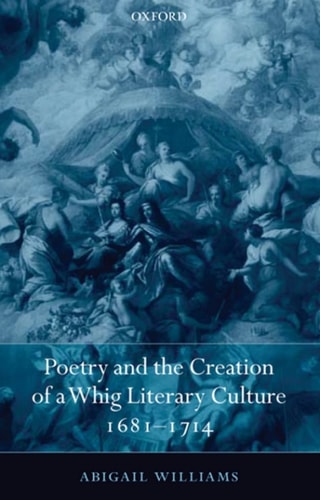
Poetry and the Creation of a Whig Literary Culture: 1681-1714
0
0
As an Amazon Associate and affiliate partner, Menrva Books earns from qualifying purchases. Learn more
Author Description
Poetry and the Creation of a Whig Literary Culture offers a new perspective on early eighteenth century poetry and literary culture, arguing that long-neglected Whig poets such as Joseph Addison, John Dennis, Thomas Tickell, and Richard Blackmore were more popular and successful in their own time than they have been since. These and other Whig writers produced elevated poetry celebrating the political and military achievements of William III's Britain, and were committed to an ambitious project to create a distinctively Whiggish English literary culture after the Revolution of 1688. Far from being the penniless hacks and dunces satirized by John Dryden and the Scriblerians, they were supported by the patronage of the wealthy Whig aristocracy, and their works promoted as a new English literature to rival that of classical Greece and Rome. Poetry and the Creation of a Whig Literary Culture maps for the first time the evolution of an alternative early eighteenth-century poetic tradition which is central to our understanding of the literary history of the period.
Menrva's Summary
THE THESIS
This work investigates how Whig poets in the late seventeenth and early eighteenth centuries actively constructed a distinct literary culture to mirror their political ideologies. Abigail Williams, a scholar of eighteenth-century literature, utilizes archival research and historical analysis to challenge the traditional narrative that these writers were merely unsuccessful hacks. She argues that figures like Joseph Addison and Richard Blackmore were central to a deliberate, well-funded project to establish a national literature that rivaled classical antiquity and celebrated the post-1688 political order.
THE SCOPE MAP
What You Will Find
- Analysis of the literary output of Whig poets between 1681 and 1714.
- Examination of the patronage systems supporting Whig writers.
- Discussion of the rivalry between Whig poets and the Scriblerians.
- Contextualization of poetry within the political climate of William III's Britain.
Scope Limits
- The study focuses primarily on the specific period between 1681 and 1714.
- It does not provide a comprehensive biography of every mentioned poet.
THE AUTHORITY PERSPECTIVE
Scholars recognize this text as a significant revisionist study that successfully challenges long-standing biases in literary history regarding the quality and influence of Whig poetry. Readers frequently note the academic density of the prose, which is intended for specialists in eighteenth-century British literature and political history.
Page Count:
304
Publication Date:
2005-01-01
Publisher:
Oxford University Press
ISBN-10:
0191531219
ISBN-13:
9780191531217
History
Poetry
English
British History
Literary Criticism
Political History
English & College Success
18th century
Community Tags
Similar Books