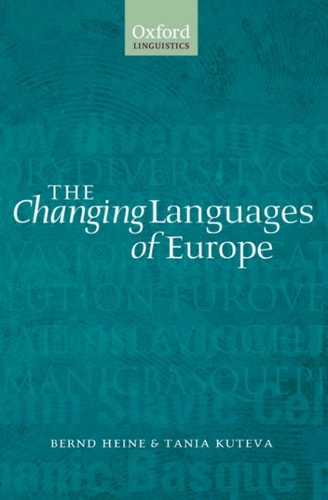
The Changing Languages of Europe
0
0
As an Amazon Associate and affiliate partner, Menrva Books earns from qualifying purchases. Learn more
Author Description
The languages and dialects of Europe, this book shows, are becoming increasingly alike. Furthermore this unifying process goes at least as far back as the Roman empire, is accelerating, and affects every one of Europe's 150 or so languages including those of different families such as Basque and Finnish. The changes are by no means restricted to lexical borrowing but involve every grammatical aspect of the language. They are usually so minute that neither native speakers nor trained linguists notice them. But they accumulate and give rise to new grammatical structures that lead in turn to new patterns of areal relationship. Professor Heine and Professor Kuteva look for the causes of linguistic change in cultural and economic exchanges across national and regional boundaries and in the processes that occur when speakers learn or are in close contact with another language. Testing their data and conclusions against findings from elsewhere in the world, the authors reconstruct and reveal when, how, and why common grammatical structures have evolved and continue to evolve in processes of change that will, they argue, transform the linguistic landscape of Europe. The book is written in clear, non-technical language. It will appeal to scholars and students of language change and variation in Europe and elsewhere. It will also interest everyone concerned to understand the nature of language and language change.
Menrva's Summary
THE THESIS
This book investigates the mechanisms driving the increasing grammatical convergence of European languages and dialects over time. Authors Bernd Heine and Tania Kuteva, both established linguistics scholars, utilize a broad comparative framework to argue that cultural and economic exchanges, rather than mere lexical borrowing, are fundamentally reshaping the grammatical structures of over 150 European languages. By analyzing these subtle, cumulative shifts, the authors provide a comprehensive model for understanding how areal relationships evolve through sustained cross-linguistic contact.
THE SCOPE MAP
What You Will Find
- Analysis of grammatical convergence across 150 European languages including non-Indo-European families like Basque and Finnish.
- Examination of the role of cultural and economic exchange in linguistic evolution.
- Comparative data testing European findings against global linguistic patterns.
Scope Limits
- The text focuses primarily on grammatical evolution rather than phonological or purely lexical shifts.
- It does not provide an exhaustive dictionary of specific dialectal changes but rather focuses on structural trends.
THE AUTHORITY PERSPECTIVE
Experts recognize this work as a significant contribution to the study of language contact and areal linguistics. Readers frequently note that while the subject matter is complex, the authors maintain a clear and accessible prose style suitable for both students and professional linguists.
Page Count:
376
Publication Date:
2006-01-01
Publisher:
OUP Oxford
ISBN-10:
0191538116
ISBN-13:
9780191538117
English & College Success
English
Linguistics
Languages In Contact
European History
Academic
Community Tags
Similar Books