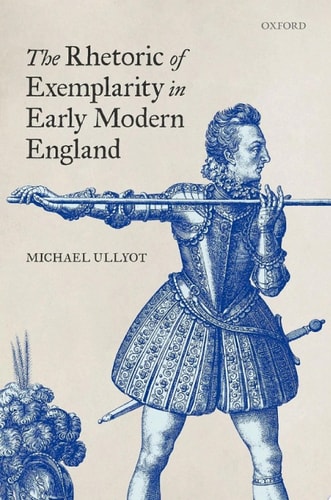
The Rhetoric of Exemplarity in Early Modern England
0
0
As an Amazon Associate and affiliate partner, Menrva Books earns from qualifying purchases. Learn more
Author Description
In this study, Michael Ullyot makes two new arguments about the rhetoric of exemplarity in late Elizabethan and Jacobean culture: first, that exemplarity is a recursive cycle driven by rhetoricians' words and readers' actions; and second, that positive moral examples are not replicable, but rather aspirational models of readers' posthumous biographies. For example, Alexander the Great envied Achilles less for his exemplary life than for Homer's account of it. Ullyot defines the three types of decorum on which exemplary rhetoric and imitation rely, and charts their operations through Philip Sidney's poetics, Edmund Spenser's poetry, and the dedications, sermons, elegies, biographies, and other occasional texts about Robert Devereux, second earl of Essex, and Henry, Prince of Wales. Ullyot expands the definition of occasional texts to include those that criticize their circumstances to demand better ones, and historicizes moral exemplarity in the contexts of sixteenth-century Protestant memory and humanist pedagogy. The Rhetoric of Exemplarity in Early Modern England concludes that all exemplary subjects suffer from the problem of metonymy, the objection that their chosen excerpts misrepresent their missing parts. This problem also besets historicist literary criticism, ever subject to corrections from the archive, so this study concedes that its own rhetorical methods are exemplary.
Menrva's Summary
THE THESIS
This study investigates how the rhetoric of exemplarity functioned as a recursive cycle between textual representation and reader action in late Elizabethan and Jacobean culture. Michael Ullyot, drawing on his expertise in early modern literature, argues that positive moral examples were not intended for direct replication but served as aspirational models for posthumous biographies. He posits that the inherent metonymic nature of exemplary subjects creates a tension between the excerpted life and the missing historical context, a limitation that also applies to the practice of historicist literary criticism itself.
THE SCOPE MAP
What You Will Find
- Analysis of decorum types in exemplary rhetoric and imitation.
- Examination of works by Philip Sidney and Edmund Spenser.
- Study of occasional texts including sermons, elegies, and dedications concerning the Earl of Essex and Henry, Prince of Wales.
- Integration of Protestant memory and humanist pedagogy contexts.
Scope Limits
- The study focuses specifically on late Elizabethan and Jacobean cultural artifacts.
- It does not provide a comprehensive survey of all early modern rhetorical figures, concentrating instead on the specific mechanics of moral exemplarity.
THE AUTHORITY PERSPECTIVE
Scholars in the field of early modern studies frequently cite this work for its rigorous application of rhetorical theory to historical occasional texts. Experts highlight the text as a sophisticated contribution to the understanding of how Renaissance authors and readers negotiated the gap between historical figures and their literary representations.
Page Count:
376
Publication Date:
2022-01-01
Publisher:
OUP Oxford
ISBN-10:
0192666045
ISBN-13:
9780192666048
History
Rhetoric
Early Modern
English literature
Humanism
English & College Success
Rhétorique
English
In literature
Renaissance
Literary Criticism
Community Tags
Similar Books