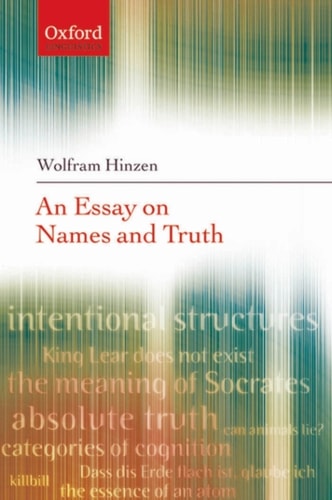
An Essay on Names and Truth
0
0
As an Amazon Associate and affiliate partner, Menrva Books earns from qualifying purchases. Learn more
Author Description
This pioneering book lays new foundations for the study of reference and truth. It seeks to explain the origins and characteristics of human ways of relating to the world by means of an understanding of the inherent structures of the mind. Wolfram Hinzen explores truth in the light of Noam Chomsky's Minimalist Program. Truth, he argues, is a function of the human mind and, in particular, likely presupposes the structure of the human clause. Professor Hinzen begins by setting out the essentials of the Minimalist Program and by considering the explanatory role played by the interfaces of the linguistic system with other cognitive systems. He then sets out an internalist reconstruction of meaning. He argues that meaning stems from concepts, originating not from reference but from intentional relations built up in human acts of language in which such concepts figure. How we refer, he suggests, is a function of the concepts we possess, rather than the reverse in which reference to the world gives us the concepts to realize it. He concludes with extended accounts of declarative sentences and names, the two aspects of language which seem most inimical to his approach. The book makes important and radical contributions to theory and debate in linguistics, philosophy, and cognitive science. The author frames his argument in a way that will be readily comprehensible to scholars and advanced students in all three disciplines.
Menrva's Summary
THE THESIS
This book investigates the fundamental relationship between human language, mental structure, and the nature of truth. Wolfram Hinzen, a professor of linguistics, utilizes the framework of Noam Chomsky's Minimalist Program to argue that truth is an internal function of the human mind rather than a product of external reference. He posits that meaning originates from conceptual intentional relations rather than direct correspondence with the world, challenging traditional externalist views of semantics.
THE SCOPE MAP
What You Will Find
- An internalist reconstruction of linguistic meaning
- An analysis of the interface between linguistic systems and cognitive systems
- Theoretical accounts of declarative sentences and proper names
- Application of the Minimalist Program to philosophical problems
Scope Limits
- The text assumes a high level of familiarity with generative grammar and formal semantics
- It does not provide an exhaustive survey of non-Chomskyan linguistic theories
THE AUTHORITY PERSPECTIVE
Scholars in linguistics and philosophy recognize this work as a significant contribution to the internalist tradition of language study. Readers frequently note the academic density of the prose, which is intended for advanced students and researchers in cognitive science and philosophy.
Page Count:
320
Publication Date:
2007-01-01
Publisher:
OUP Oxford
ISBN-10:
0191534420
ISBN-13:
9780191534423
English
Semantics
Linguistics
Philosophy of
English & College Success
Community Tags
Similar Books