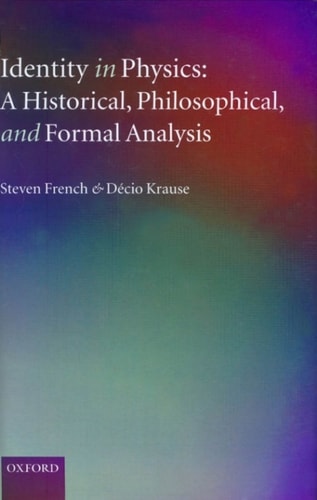
Identity in Physics: A Historical, Philosophical, and Formal Analysis
0
0
As an Amazon Associate and affiliate partner, Menrva Books earns from qualifying purchases. Learn more
Author Description
Can quantum particles be regarded as individuals, just like books, tables and people? According to the 'received' view - articulated by several physicists in the immediate aftermath of the quantum revolution - quantum physics itself tells us they cannot: quantum particles, unlike their classical counterparts, must be regarded as 'non-individuals' in some sense. However, recent work has indicated that this is not the whole story and that the theory is also consistent with the position that such particles can be taken to be individuals, albeit at a metaphysical price. Drawing on philosophical accounts of identity and individuality, as well as the histories of both classical and quantum physics, the authors explore these two alternative metaphysical packages. In particular, they argue that if quantum particles are regarded as individuals, then Leibniz's famous Principle of the Identity of Indiscernibles is in fact violated. Recent discussions of this conclusion are analysed in detail and, again, the costs involved in saving the Principle are carefully considered. Taking the alternative package, the authors deploy recent work in non-standard logic and set theory to indicate how we can make sense of the idea that objects can be non-individuals. The concluding chapter suggests how these results might then be extended to quantum field theory. Identity in Physics brings together a range of work in this area and further develops the authors' own contributions to the debate. Uniquely, as the title indicates, it situates this work in the appropriate formal, historical, and philosophical contexts.
Menrva's Summary
THE THESIS
This book investigates whether quantum particles possess individual identity or if they must be classified as non-individuals within the framework of physical theory. The authors, Décio Krause and Steven French, synthesize historical developments in physics with contemporary philosophical logic to evaluate the metaphysical implications of quantum mechanics. They argue that treating quantum particles as individuals necessitates a violation of Leibniz's Principle of the Identity of Indiscernibles, while alternative models require non-standard logical and set-theoretic structures to maintain a non-individualist perspective.
THE SCOPE MAP
What You Will Find
- Historical analysis of the quantum revolution and its impact on particle ontology
- Application of non-standard logic and quasi-set theory to quantum systems
- Evaluation of Leibniz's Principle of the Identity of Indiscernibles in a quantum context
- Theoretical extension of identity concepts into quantum field theory
Scope Limits
- Does not provide an introductory overview of basic quantum mechanics for lay readers
- Excludes experimental laboratory data in favor of formal and conceptual analysis
THE AUTHORITY PERSPECTIVE
Experts recognize this work as a rigorous contribution to the philosophy of physics, particularly for its technical integration of formal logic and metaphysical inquiry. Readers frequently note the academic density of the prose, which requires a strong background in both theoretical physics and analytic philosophy to navigate effectively.
Page Count:
448
Publication Date:
2006-01-01
Publisher:
Clarendon Press
ISBN-10:
0191535222
ISBN-13:
9780191535222
Philosophy
Logic
Metaphysics
Individuality
Physics
Science History
Community Tags
Similar Books