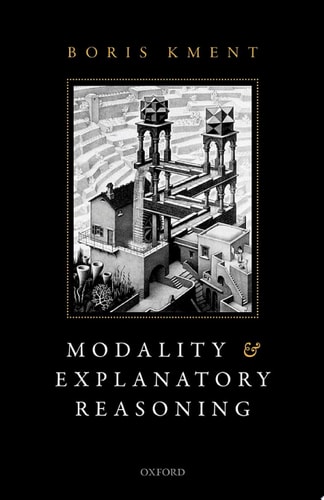
Modality and Explanatory Reasoning
0
0
As an Amazon Associate and affiliate partner, Menrva Books earns from qualifying purchases. Learn more
Author Description
Since the ground-breaking work of Saul Kripke, David Lewis, and others in the 1960s and 70s, one dominant interest of analytic philosophers has been in modal truths, which concerns the questions of what is possible and what is necessary. However, there is considerable controversy over the source and nature of necessity. In Modality and Explanatory Reasoning, Boris Kment takes a novel approach to the study of modality that places special emphasis on understanding the origin of modal notions in everyday thought. Kment argues that the concepts of necessity and possibility originate in a common type of thought experiment—counterfactual reasoning—that allows us to investigate explanatory connections. This procedure is closely related to the controlled experiments of empirical science. Necessity is defined in terms of causation and other forms of explanation such as grounding, the relation that connects metaphysically fundamental facts to non-fundamental ones. Therefore, contrary to a widespread view, explanation is more fundamental than modality. The study of modal facts is important for philosophy, not because these facts are of much metaphysical interest in their own right, but because they provide evidence about explanatory relationships. In the course of developing this position, the book offers new accounts of possible worlds, counterfactual conditionals, essential truths and their role in grounding, and a novel theory of how counterfactuals relate to causation and explanation.
Menrva's Summary
THE THESIS
This book investigates the fundamental source and nature of modal truths by arguing that necessity and possibility are derived from explanatory reasoning rather than being metaphysically primary. Boris Kment, a philosopher specializing in metaphysics and logic, challenges the traditional view that modal facts exist independently. He proposes that modal concepts originate in counterfactual reasoning, which functions as a cognitive tool for identifying explanatory connections. By prioritizing causation and grounding over modality, Kment provides a framework where modal facts serve as evidence for deeper explanatory relationships.
THE SCOPE MAP
What You Will Find
- A theory defining necessity through causation and grounding
- An analysis of the relationship between counterfactual conditionals and empirical experiments
- New accounts of possible worlds and essential truths
Scope Limits
- The text does not provide a comprehensive history of modal logic beyond the Kripke-Lewis tradition
- It does not address non-analytic or continental approaches to modal philosophy
THE AUTHORITY PERSPECTIVE
Philosophers and scholars in the field of metaphysics frequently cite this work for its rigorous re-evaluation of the hierarchy between explanation and modality. Readers often note the high level of academic density, identifying it as a significant contribution for advanced students and researchers in analytic philosophy.
Page Count:
384
Publication Date:
2014-01-01
Publisher:
OUP Oxford
ISBN-10:
0191056715
ISBN-13:
9780191056710
Philosophy
Epistemology
Logic
Knowledge Theory
Metaphysics
Reasoning
Community Tags
Other Editions(4)


Similar Books







Reader Comments
Share Your Thoughts
No comments yet. Be the first to share your thoughts!