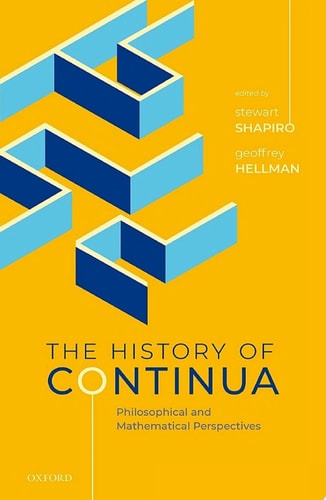
The History of Continua: Philosophical and Mathematical Perspectives
0
0
As an Amazon Associate and affiliate partner, Menrva Books earns from qualifying purchases. Learn more
Author Description
Mathematical and philosophical thought about continuity has changed considerably over the ages. Aristotle insisted that continuous substances are not composed of points, and that they can only be divided into parts potentially. There is something viscous about the continuous. It is a unified whole. This is in stark contrast with the prevailing contemporary account, which takes a continuum to be composed of an uncountably infinite set of points. This vlume presents a collective study of key ideas and debates within this history. The opening chapters focus on the ancient world, covering the pre-Socratics, Plato, Aristotle, and Alexander. The treatment of the medieval period focuses on a (relatively) recently discovered manuscript, by Bradwardine, and its relation to medieval views before, during, and after Bradwardine's time. In the so-called early modern period, mathematicians developed the calculus and, with that, the rise of infinitesimal techniques, thus transforming the notion of continuity. The main figures treated here include Galileo, Cavalieri, Leibniz, and Kant. In the early party of the nineteenth century, Bolzano was one of the first important mathematicians and philosophers to insist that continua are composed of points, and he made a heroic attempt to come to grips with the underlying issues concerning the infinite. The two figures most responsible for the contemporary orthodoxy regarding continuity are Cantor and Dedekind. Each is treated in an article, investigating their precursors and influences in both mathematics and philosophy. A new chapter then provides a lucid analysis of the work of the mathematician Paul Du Bois-Reymond, to argue for a constructive account of continuity, in opposition to the dominant Dedekind-Cantor account. This leads to consideration of the contributions of Weyl, Brouwer, and Peirce, who once dubbed the notion of continuity "the master-key which... unlocks the arcana of philosophy". And we see that later in the twentieth ce
Menrva's Summary
THE THESIS
This volume investigates the historical evolution and conceptual shifts in the definition of the continuum, contrasting ancient holistic views with modern point-set theory. The text compiles scholarly analyses from various contributors to trace how the understanding of continuity transitioned from Aristotle's indivisible substances to the contemporary mathematical orthodoxy established by Cantor and Dedekind. By examining key figures across centuries, the work highlights the tension between constructive accounts of continuity and the prevailing infinite-set framework.
THE SCOPE MAP
What You Will Find
- Historical analysis of continuity from the pre-Socratics through the twentieth century.
- Detailed examinations of Aristotle, Bradwardine, Galileo, Leibniz, Kant, Bolzano, Cantor, and Dedekind.
- Critical evaluation of constructive alternatives to standard set-theoretic models, including the work of Paul Du Bois-Reymond, Weyl, and Brouwer.
Scope Limits
- The text does not provide a comprehensive survey of every minor mathematical development in calculus.
- It focuses primarily on the intersection of philosophy and mathematics rather than purely technical pedagogical instruction.
THE AUTHORITY PERSPECTIVE
Experts identify this collection as a rigorous resource for those interested in the intersection of mathematical history and metaphysical inquiry. Readers frequently note the academic density of the prose, which is best suited for scholars and advanced students of philosophy or mathematics.
Page Count:
587
Publication Date:
2020-01-01
Publisher:
OUP Oxford
ISBN-10:
0192638475
ISBN-13:
9780192638472
Philosophy
Mathematics
Metaphysics
Science History
History & Surveys
Logic
Community Tags
Similar Books