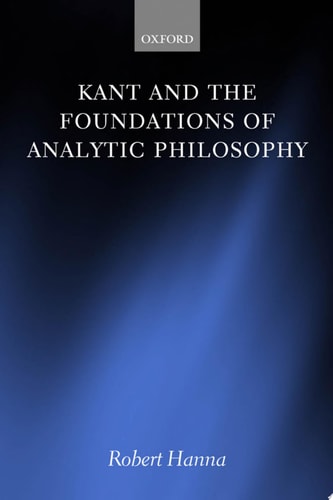
Kant and the Foundations of Analytic Philosophy
0
0
As an Amazon Associate and affiliate partner, Menrva Books earns from qualifying purchases. Learn more
Author Description
Robert Hanna presents a fresh view of the Kantian and analytic traditions that have dominated continental European and Anglo-American philosophy over the last two centuries, and of the relation between them. The rise of analytic philosophy decisively marked the end of the hundred-year dominance of Kant's philosophy in Europe. But Hanna shows that the analytic tradition also emerged from Kant's philosophy in the sense that its members were able to define and legitimate their ideas only by means of an intensive, extended engagement with, and a partial or complete rejection of, the Critical Philosophy. Hanna's book therefore comprises both an interpretative study of Kant's massive and seminal Critique of Pure Reason, and a critical essay on the historical foundations of analytic philosophy from Frege to Quine. Hanna considers Kant's key doctrines in the Critique in the light of their reception and transmission by the leading figures of the analytic tradition--Frege, Moore, Russell, Wittgenstein, Carnap, and Quine. But this is not just a study in the history of philosophy, for out of this emerges Hanna's original approach to two much-contested theories that remain at the heart of contemporary philosophy. Hanna puts forward a new 'cognitive-semantic' interpretation of transcendental idealism, and a vigorous defence of Kant's theory of analytic and synthetic necessary truth. These will make Kant and the Foundations of Analytic Philosophy compelling reading not just for specialists in the history of philosophy, but for all who are interested in these fundamental philosophical issues.
Menrva's Summary
THE THESIS
This book investigates the historical and conceptual relationship between Immanuel Kant’s Critical Philosophy and the subsequent development of the analytic tradition in philosophy. Robert Hanna, a scholar of Kantian thought, utilizes a comparative framework to argue that analytic philosophy did not merely replace Kantianism but emerged through a complex process of engagement, critique, and partial rejection of the Critique of Pure Reason. By examining the works of figures such as Frege, Russell, and Quine, Hanna establishes a bridge between classical transcendental idealism and modern analytic concerns.
THE SCOPE MAP
What You Will Find
- A detailed re-examination of Kant's Critique of Pure Reason.
- A historical analysis of the analytic tradition from Gottlob Frege to W.V.O. Quine.
- A proposed 'cognitive-semantic' interpretation of transcendental idealism.
- A defense of Kantian theories regarding analytic and synthetic necessary truths.
Scope Limits
- The text does not provide a comprehensive history of Continental philosophy outside of its relation to the analytic tradition.
- It focuses primarily on the epistemological and semantic aspects of Kant's work rather than his moral or political philosophy.
THE AUTHORITY PERSPECTIVE
Scholars and students of philosophy frequently cite this work as a significant contribution to the historiography of analytic philosophy. Experts note the high academic density of the prose, which is intended for readers already familiar with the technical terminology of both Kantian and analytic discourse.
Page Count:
328
Publication Date:
2001-01-01
Publisher:
Clarendon Press
ISBN-10:
0191544043
ISBN-13:
9780191544040
Philosophy
History & Surveys
Epistemology
Philosophy history
Metaphysics
Kant
Community Tags
Other Editions(4)
Similar Books






Reader Comments
Share Your Thoughts
No comments yet. Be the first to share your thoughts!