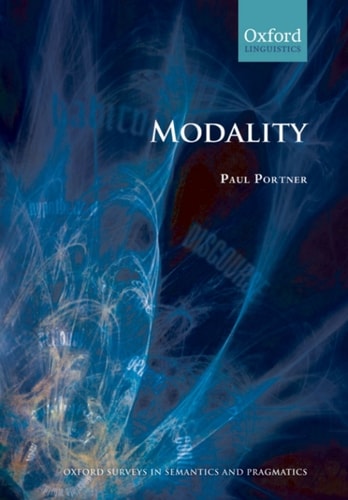
Modality (Oxford Surveys in Semantics & Pragmatics)
0
0
As an Amazon Associate and affiliate partner, Menrva Books earns from qualifying purchases. Learn more
Author Description
This is a book about semantic theories of modality. Its main goal is to explain and evaluate important contemporary theories within linguistics and to discuss a wide range of linguistic phenomena from the perspective of these theories. The introduction describes the variety of grammatical phenomena associated with modality, explaining why modal verbs, adjectives, and adverbs represent the core phenomena. Chapters are then devoted to the possible worlds semantics for modality developed in modal logic; current theories of modal semantics within linguistics; and the most important empirical areas of research. The author concludes by discussing the relation between modality and other topics, especially tense, aspect, mood, and discourse meaning. Paul Portner's accessible guide to this key area of current research will be welcomed by students of linguistics at graduate level and above, as well as by researchers in philosophy, computational science, and related fields.
Menrva's Summary
THE THESIS
This book investigates the semantic theories of modality by evaluating contemporary linguistic frameworks and their application to diverse grammatical phenomena. Paul Portner, a specialist in semantics and pragmatics, synthesizes modal logic with linguistic data to provide a structured overview of how modal verbs, adjectives, and adverbs function within language. The text serves as a comprehensive examination of the intersection between formal logic and natural language expression.
THE SCOPE MAP
What You Will Find
- Possible worlds semantics for modality
- Current linguistic theories of modal semantics
- Analysis of modal verbs, adjectives, and adverbs
- Intersections between modality, tense, aspect, and discourse meaning
Scope Limits
- Does not provide an exhaustive history of philosophical logic beyond its application to linguistics
- Focuses primarily on formal semantic approaches rather than sociolinguistic or purely descriptive variations
THE AUTHORITY PERSPECTIVE
Experts and graduate students frequently cite this work as a foundational text for understanding the formalization of modality in linguistics. Readers note the technical density of the prose, which is tailored for those already familiar with semantic theory and logic.
Page Count:
320
Publication Date:
2009-01-01
Publisher:
OUP Oxford
ISBN-10:
0191558966
ISBN-13:
9780191558962
Semantics
Pragmatics
English
English & College Success
Linguistics
Philosophy of
Modal Logic
Community Tags
Similar Books