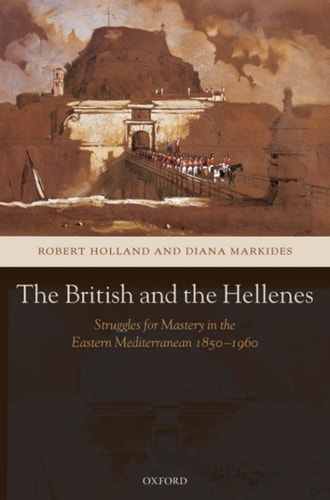
The British and the Hellenes: Struggles for Mastery in the Eastern Mediterranean 1850-1960
0
0
As an Amazon Associate and affiliate partner, Menrva Books earns from qualifying purchases. Learn more
Author Description
The Greek revolt against Turkish rule in the 1820s, and the ensuing establishment of an independent Hellenic Kingdom, was the principal precursor of an age of nationalism in the eastern Mediterranean world. Amongst the Great Powers, Great Britain thereafter played the most critical role in struggles to expand the frontiers of Greece beyond their initially confined extent. Through a focus on events leading to the cession of the Ionian Islands to Greece in 1864, the often bloody process of Cretan unification climaxing in 1913, the adhesion of the Dodecanese to Greece in 1948, and the travails of British colonial rule in Cyprus through to independence in 1960, the book develops a comparative overview of the United Kingdom's engagements with the modern Hellenic experience. At the heart of the various themes covered by this volume is the interaction between internal and external forces shaping the futures of divided island societies. In exploring the resulting patterns the authors provide an original insight into the political and social morphology of the eastern Mediterranean. Although the principal context is provided by Anglo-Hellenic relations, the nature of the struggles necessitate a close attention to Ottoman decline and post-Ottoman succession, Great Power rivalries, ethnic and communal disintegration, the early history of international peace-keeping, and decolonization after 1945. In tracing these preoccupations, the often neglected significance of the eastern Mediterranean is more accurately situated in relation to British authority overseas and its limits. Although the policy process is carefully charted, the essential concern is with struggles of mastery within islands where Britons and Greeks, amongst others, found themselves frequently at odds. In evoking the engagement between British power and Hellenic nationalism, a fresh perspective is given to the modern history of the eastern Mediterranean, and the Balkan and Near Eastern worlds to which they were int
Menrva's Summary
THE THESIS
This volume investigates the complex geopolitical and social dynamics of Anglo-Hellenic relations and the struggle for mastery in the eastern Mediterranean between 1850 and 1960. Authors Diana Markides and Robert Holland utilize extensive historical records to analyze how British imperial interests intersected with the rise of Greek nationalism. The work argues that the interaction between internal communal tensions and external Great Power rivalries fundamentally shaped the political morphology of the region during the decline of the Ottoman Empire and the subsequent era of decolonization.
THE SCOPE MAP
What You Will Find
- Historical analysis of the Ionian Islands cession, Cretan unification, Dodecanese adhesion, and the Cyprus emergency.
- Examination of the intersection between British colonial administration and local nationalist movements.
- Comparative study of island societies under the influence of shifting imperial and regional powers.
Scope Limits
- The text focuses primarily on Anglo-Hellenic interactions, potentially limiting depth on other regional actors like Italy or Russia except where they directly impact British policy.
- The analysis is bounded by the 1850-1960 timeframe, excluding the post-independence developments of the late 20th century.
THE AUTHORITY PERSPECTIVE
Historians and regional experts recognize this work as a rigorous examination of the intersection between imperial policy and local nationalist aspirations. Readers frequently note the academic density of the prose, which provides a detailed, scholarly account of the diplomatic and social complexities inherent in the eastern Mediterranean during this period.
Page Count:
280
Publication Date:
2006-01-01
Publisher:
Oxford University Press
ISBN-10:
0191554685
ISBN-13:
9780191554681
History
International relations
Diplomatic History
European History
Community Tags
Similar Books





Reader Comments
Share Your Thoughts
No comments yet. Be the first to share your thoughts!