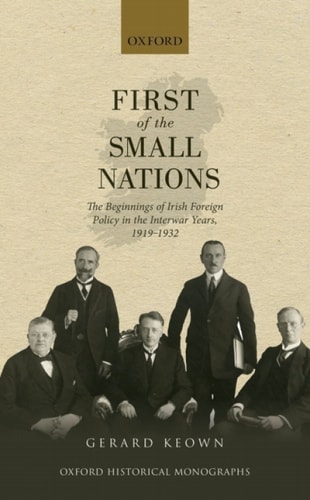
First of the Small Nations: The Beginnings of Irish Foreign Policy in the Inter-War Years, 1919-1932
0
0
As an Amazon Associate and affiliate partner, Menrva Books earns from qualifying purchases. Learn more
Author Description
First of the Small Nations traces the ideas and aspirations of the revolutionary generation in Ireland from the 1890s to 1918 who dreamt of an independent Irish state and imagined how an Irish foreign policy might look. It follows attempts to put these ideas into practice during the campaign for independence and how they evolved into the first Irish foreign policy in the decade after independence. During these years, efforts were focused on asserting the young Irish state's independence as it pushed out the boundaries of Commonwealth membership, made a contribution at the League of Nations, and forged ties in Europe and America. Many of the ideas that continue to shape Irish foreign policy - small state and European country; honest broker and international good citizen; mother-country with a diaspora and bridge between Europe and America - have their roots in this period. There is a strong modern and internationalist vein running through Irish nationalism, including outside ideas on how the international order should be arranged - from the desire to pursue a policy based on values, to attempts to create an international rationale for independence, and an understanding of the influence of public opinion. First of the Small Nations also shines a light on interwar European relations and how small states managed their affairs in a world system dominated by their larger neighbours. Drawing on a rich vein of archival sources and private papers, this study charts the beginnings of Irish foreign policy and the aspiration to be 'first of the small nations'.
Menrva's Summary
THE THESIS
This work investigates the origins and development of Irish foreign policy during the formative inter-war years of 1919 to 1932. Gerard Keown, a scholar of Irish diplomatic history, utilizes extensive archival research and private papers to examine how the revolutionary generation transitioned from nationalist aspirations to the practical implementation of statecraft. The book argues that the foundational principles of modern Irish diplomacy—including its identity as a small state, an internationalist actor, and a bridge between continents—were established during this specific period of post-independence consolidation.
THE SCOPE MAP
What You Will Find
- Analysis of Irish diplomatic efforts within the League of Nations.
- Examination of the evolution of Commonwealth membership boundaries.
- Historical documentation of early Irish relations with Europe and the United States.
- Exploration of the ideological roots of Irish nationalism regarding international order.
Scope Limits
- The study focuses primarily on the period between 1919 and 1932 and does not cover the later developments of the mid-to-late 20th century.
- The text prioritizes diplomatic and political history over detailed social or economic analysis of the Irish domestic state.
THE AUTHORITY PERSPECTIVE
Historians and political scientists recognize this monograph as a definitive account of the early Irish diplomatic service. Readers frequently note the academic density of the prose, which provides a rigorous examination of primary source material for specialists in the field.
Page Count:
320
Publication Date:
2016-01-01
Publisher:
OUP Oxford
ISBN-10:
0191062413
ISBN-13:
9780191062414
History
International relations
Irish History
20th Century
European History
Diplomatic History
Community Tags
Similar Books