Poetry and Parental Bereavement in Early Modern Lutheran Germany
0
0
As an Amazon Associate and affiliate partner, Menrva Books earns from qualifying purchases. Learn more
Author Description
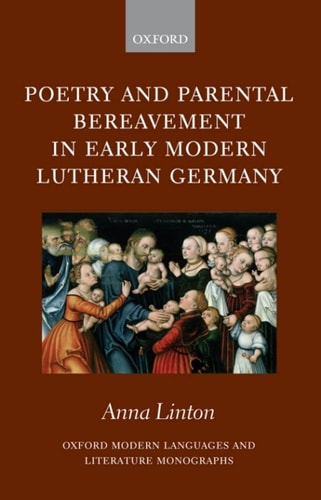
In early modern Europe it has been estimated that up to one in two children did not survive to the age of ten. In the light of this high mortality rate, some historians have argued that parents did not form close relationships with their children, especially the very young. This is clearly refuted by the testimony of bereaved parents such as Martin Luther, and by the volume of consolatory writings produced for grieving families in early modern Lutheran Germany. The authors, clergymen and lay people, regarded grief as a deep wound which required treatment, and they applied the balm of consolation through sermons, tracts and occasional poetry. This study analyses these writings, focusing particularly on the neglected genre of the epicedium (funeral poem). It asks how and why poetry was used to counter the affective impact of parental bereavement, and considers what makes it a suitable vehicle for consolation. The poems, which are analyzed against the contemporary theological, philosophical, and poetological background, are taken from Leichenpredigten (printed funeral booklets), as well as from collections by two contrasting poets, Paul Fleming (1609-40), an unmarried man who wrote to console others, and Margarethe Susanna von Kuntsch (1651-1717), who lost thirteen of her fourteen children. The study seeks to rehabilitate a neglected genre and participates in discussions on the sociology of death, Lutheran teachings about death and mourning, literary presentations of mortality and loss, and the depiction of children and parent-child relations in literature.
Menrva's Summary
THE THESIS
This study investigates how early modern Lutheran Germans utilized funeral poetry as a primary mechanism to process and console parental grief in the face of high infant and child mortality rates. Anna Linton, a scholar of early modern German literature, examines the intersection of theological doctrine, philosophical thought, and poetic tradition. She argues that these texts serve as vital historical evidence that contradicts the notion that parents of the period were emotionally detached from their children, demonstrating instead a profound and articulated culture of mourning.
THE SCOPE MAP
What You Will Find
- Analysis of the epicedium genre within the context of Leichenpredigten (funeral booklets).
- Comparative study of works by Paul Fleming and Margarethe Susanna von Kuntsch.
- Examination of Lutheran theological and poetological frameworks regarding death.
Scope Limits
- The study focuses specifically on the Lutheran tradition in Germany and does not provide a comprehensive survey of Catholic or Reformed mourning practices.
- It does not attempt to analyze the entire corpus of early modern funeral poetry, focusing instead on representative case studies.
THE AUTHORITY PERSPECTIVE
Scholars in the field of early modern studies recognize this work as a significant contribution to the history of emotions and the sociology of death. The text is noted for its rigorous academic approach and its success in bringing a neglected literary genre into the broader discourse of seventeenth-century cultural history.
Page Count:
300
Publication Date:
2008-01-01
Publisher:
OUP Oxford
ISBN-10:
0191552771
ISBN-13:
9780191552779
Poetry
History
Theology
English
English & College Success
Early Modern
Sociology of Death
Literary Criticism