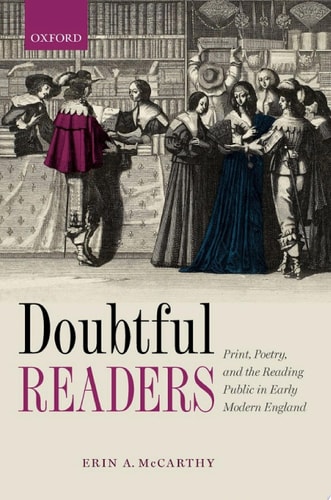
Doubtful Readers: Print, Poetry, and the Reading Public in Early Modern England
0
0
As an Amazon Associate and affiliate partner, Menrva Books earns from qualifying purchases. Learn more
Author Description
When poetry was printed, poets and their publishers could no longer take for granted that readers would have the necessary knowledge and skill to read it well. By making poems available to anyone who either had the means to a buy a book or knew someone who did, print publication radically expanded the early modern reading public. These new readers, publishers feared, might not buy or like the books. Worse, their misreadings could put the authors, the publishers, or the readers themselves at risk. Doubtful Readers: Print, Poetry, and the Reading Public in Early Modern England focuses on early modern publishers' efforts to identify and accommodate new readers of verse that had previously been restricted to particular social networks in manuscript. Focusing on the period between the maturing of the market for printed English literature in the 1590s and the emergence of the professional poet following the Restoration, this study shows that poetry was shaped by--and itself shaped--strong print publication traditions. By reading printed editions of poems by William Shakespeare, Aemilia Lanyer, John Donne, and others, this book shows how publishers negotiated genre, gender, social access, reputation, literary knowledge, and the value of English literature itself. It uses literary, historical, bibliographical, and quantitative evidence to show how publishers' strategies changed over time. Ultimately, Doubtful Readers argues that although--or perhaps because--publishers' interpretive and editorial efforts are often elided in studies of early modern poetry, their interventions have had an enduring impact on our canons, texts, and literary histories.
Menrva's Summary
THE THESIS
This study investigates how the transition of poetry from private manuscript circulation to public print publication in early modern England forced publishers to develop new strategies for managing reader interpretation and market risk. Author Erin A. McCarthy, a scholar of early modern literature and book history, utilizes a combination of bibliographical, historical, and quantitative evidence to analyze how publishers navigated the anxieties surrounding a broader, less predictable reading public. The work argues that these editorial interventions were not merely peripheral but were foundational in shaping the literary canon and the professional identity of poets between the 1590s and the Restoration.
THE SCOPE MAP
What You Will Find
- Analysis of the shift from manuscript culture to the commercial print market for poetry.
- Examination of editorial strategies regarding genre, gender, and social access in printed editions.
- Case studies of works by William Shakespeare, Aemilia Lanyer, and John Donne.
- Quantitative data regarding the development of the English literary market.
Scope Limits
- The study focuses specifically on the period between the 1590s and the Restoration.
- It does not provide a comprehensive history of all early modern literature, focusing primarily on the intersection of poetry and print publication.
THE AUTHORITY PERSPECTIVE
Scholars in the field of book history and early modern studies recognize this text as a significant contribution to understanding the material conditions of literary production. Readers frequently note the academic density of the prose and the precision with which McCarthy integrates bibliographical evidence into her historical arguments.
Page Count:
304
Publication Date:
2020-01-01
Publisher:
OUP Oxford
ISBN-10:
0192573578
ISBN-13:
9780192573575
Poetry
History
English
Book History
Early Modern
English poetry
English & College Success
Literary Criticism
Publishing Studies
Publishers and publishing
Community Tags
Similar Books