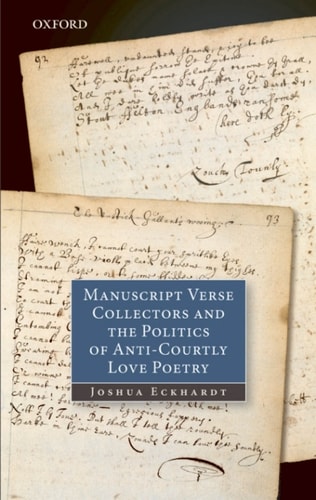
Manuscript Verse Collectors and the Politics of Anti-Courtly Love Poetry
0
0
As an Amazon Associate and affiliate partner, Menrva Books earns from qualifying purchases. Learn more
Author Description
This book reappraises the work of early-seventeenth-century collectors of English Renaissance poetry in manuscript. The verse miscellanies, or poetry anthologies, of these collectors have long attracted the attention of literary editors looking for texts by individual, major authors, and they have more recently interested historians for their poems on affairs of state, called verse libels. By contrast, this book investigates the relationships that the compilers of miscellanies established between such presumably literary and political texts. It focuses on two of the most popular, and least printable, literary genres that they collected: libels, and anti-courtly love poetry, a literary mode that the collectors of John Donne's poems played a major role in establishing. They made Donne the most popular poet in manuscripts of the period, and they demonstrated a special affinity for his most erotic or obscene poems, such as 'To his Mistress going to bed' and 'The Anagram'. Donne collectors also exhibited the similarities between these Ovidian love elegies and the sexually explicit or counter-Petrarchan verse of other authors, thereby organizing a literary genre opposed to the conventions of courtly love lyrics. Furthermore, collectors politicized this genre by relating examples of it to libels. In so doing, manuscript verse collectors demonstrated a type of literary and political activity distinct from that of authors, stationers, and readers. Based on a thorough investigation of manuscript verse miscellanies, the book appeals to scholars and students of early modern English literature and history, Donne studies, manuscript studies, and the history of the book.
Menrva's Summary
THE THESIS
This book investigates how early-seventeenth-century manuscript collectors synthesized literary and political texts to establish a distinct cultural practice. Joshua Eckhardt, a scholar of early modern literature, utilizes a comprehensive analysis of verse miscellanies to argue that compilers actively shaped the reception of poets like John Donne. By examining the juxtaposition of anti-courtly love poetry and political libels, the author demonstrates how these collectors created a unique framework for interpreting erotic and subversive verse within the context of the period's political climate.
THE SCOPE MAP
What You Will Find
- Analysis of early-seventeenth-century English manuscript verse miscellanies.
- Examination of the intersection between Ovidian love elegies and political libels.
- Study of the editorial choices made by collectors of John Donne's poetry.
- Investigation into the development of anti-courtly love poetry as a distinct genre.
Scope Limits
- The study focuses primarily on manuscript collections rather than printed editions.
- The analysis is restricted to the early seventeenth century in England.
THE AUTHORITY PERSPECTIVE
Scholars in the fields of manuscript studies and Donne research identify this work as a significant contribution to understanding the agency of early modern compilers. Experts frequently note the rigorous archival research and the clarity with which the author connects literary genre development to contemporary political discourse.
Page Count:
320
Publication Date:
2009-01-01
Publisher:
OUP Oxford
ISBN-10:
0191569747
ISBN-13:
9780191569746
Poetry
History - Modern
English
English Renaissance
English & College Success
Book History
Literary Criticism
Community Tags
Other Editions(3)

Similar Books



Reader Comments
Share Your Thoughts
No comments yet. Be the first to share your thoughts!