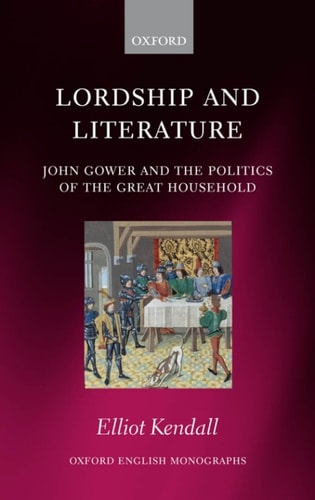
Lordship and Literature: John Gower and the Politics of the Great Household
0
0
As an Amazon Associate and affiliate partner, Menrva Books earns from qualifying purchases. Learn more
Author Description
A ground-breaking approach to the politics of late medieval texts, Lordship and Literature investigates the importance of the great household to late fourteenth-century English culture and society. A sustained new reading of John Gower's major English poem, Confessio Amantis, shows how deeply the great household informed the way Gower and his contemporaries imagined their world. Exploring royal government and gentry ambitions, this thoroughly interdisciplinary book views the period's politics and literature in terms of a household-based economy of power. The great household rode immense political shockwaves in the late fourteenth century, when royal aggrandizement and economic crisis in the wake of the Black Death challenged dominant modes of aristocratic power. Lordship and Literature examines responses to these challenges, analysing texts including the Appeal of the Merciless Parliament, imagination of lordly power by Chaucer, Gower, and Clanvowe, and parliamentary controversy over livery and justice. The economics of power-described by thinkers such as Pierre Bourdieu and Marcel Mauss-spans Ricardian political and literary culture, informing elite politics and love allegory alike. Competing models of household politics, and their literary force, are revealed here in wide-ranging interpretations of exchange (of women, hospitality, livery, loyalty, retribution) in Gower's complex and influential poem. Lordship and Literature locates Confessio Amantis firmly in its historical moment, arguing that the poem belongs to a powerful yet embattled aristocratic politics.
Menrva's Summary
THE THESIS
This work investigates how the structure and culture of the late fourteenth-century great household functioned as a primary site for political and literary production in England. Elliot Kendall, a scholar of medieval literature, utilizes a framework rooted in the sociology of power—specifically the theories of Pierre Bourdieu and Marcel Mauss—to analyze how economic and social pressures following the Black Death shaped the literary output of figures such as John Gower, Geoffrey Chaucer, and Thomas Clanvowe. The book argues that the great household was not merely a domestic space but a critical political institution that mediated the relationship between royal authority and aristocratic ambition.
THE SCOPE MAP
What You Will Find
- Analysis of the political and economic influence of the great household in Ricardian England.
- A sustained reading of John Gower's 'Confessio Amantis' within its historical context.
- Examination of the 'economics of power' including the exchange of hospitality, livery, and loyalty.
- Comparative study of literary texts alongside historical documents like the Appeal of the Merciless Parliament.
Scope Limits
- The study focuses primarily on the late fourteenth century and does not provide a comprehensive survey of medieval household structures across the entire Middle Ages.
- The analysis is centered on the intersection of literature and political theory rather than a general social history of the period.
THE AUTHORITY PERSPECTIVE
Scholars and critics recognize this text as a significant contribution to the study of Ricardian literature and the socio-political context of the late medieval period. Readers frequently note the academic density of the prose and the rigorous application of sociological theory to literary analysis.
Page Count:
320
Publication Date:
2008-01-01
Publisher:
Oxford University Press
ISBN-10:
019156219X
ISBN-13:
9780191562198
Households
In literature
English & College Success
Literary Criticism
English
Power Social sciences
Political History
English literature
Community Tags
Similar Books