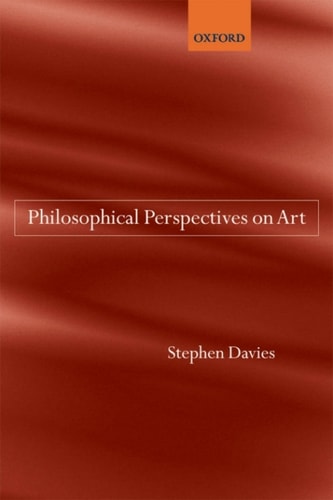
Philosophical Perspectives on Art
0
0
As an Amazon Associate and affiliate partner, Menrva Books earns from qualifying purchases. Learn more
Author Description
Philosophical Perspectives on Art presents a series of essays devoted to two of the most fundamental topics in the philosophy of art: the distinctive character of artworks and what is involved in understanding them as art. In Part I, Stephen Davies considers a wide range of questions about the nature and definition of art. Can art be defined, and if so, which definitions are the most plausible? Do we make and consume art because there are evolutionary advantages to doing so? Has art completed the mission that guided its earlier historical development, and if so, what is to become of it now? Should architecture be classified as an art form? Part II turns to the interpretation and appreciation of art. What is the target and purpose of the critic's interpretation? Is interpretation primarily directed at uncovering artists' intended meanings? Can apparently contradictory interpretations of a given piece both be true? Are interpretative evaluations entailed by descriptions of a work's aesthetic and artistic characteristics? In addition to providing fresh answers to these and other central questions in aesthetics, Davies considers the nature and content of metaphor, and the relation between the expressive qualities of a work of art and the emotions of its creator.
Menrva's Summary
THE THESIS
This collection of essays investigates the fundamental nature of art and the methodologies required for its interpretation and appreciation. Stephen Davies, a prominent philosopher of art, utilizes a structured analytical framework to address whether art possesses a definable essence and how critics should approach the evaluation of creative works. By synthesizing historical perspectives with contemporary aesthetic theory, the author provides a rigorous examination of the ontological status of artworks and the cognitive processes involved in their reception.
THE SCOPE MAP
What You Will Find
- Analysis of the definition of art and its potential evolutionary origins
- Examination of the classification of architecture as an art form
- Discussion on the role of artist intent in critical interpretation
- Exploration of the relationship between metaphor, expression, and creator emotion
Scope Limits
- The text does not provide a comprehensive history of art movements
- It does not offer a practical guide for art creation or studio techniques
THE AUTHORITY PERSPECTIVE
Experts recognize this work as a significant contribution to analytic aesthetics that effectively bridges abstract theory with concrete examples. Readers frequently note the academic density of the prose, which makes it a suitable resource for students and scholars of philosophy.
Page Count:
240
Publication Date:
2007-01-01
Publisher:
Clarendon Press
ISBN-10:
0191568651
ISBN-13:
9780191568657
Philosophy
Non-Fiction
Art
Art Theory
Aesthetics