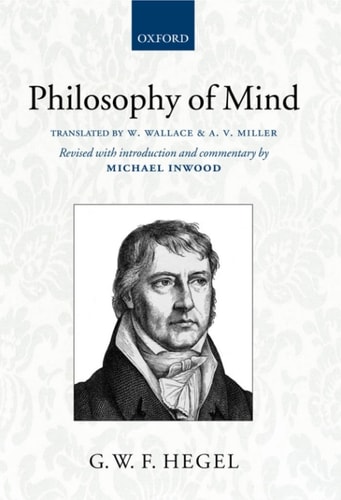
Hegel: Philosophy of Mind: Translated with Introduction and Commentary
0
0
As an Amazon Associate and affiliate partner, Menrva Books earns from qualifying purchases. Learn more
Author Description
G. W. F. Hegel is an immensely important yet difficult philosopher. Philosophy of Mind is the third part of Hegel's Encyclopaedia of the Philosophical Sciences, in which he summarizes his philosophical system. It is one of the main pillars of his thought. Michael Inwood presents this central work to the modern reader in an intelligible and accurate new translation---the first into English since 1894---that loses nothing of the style of Hegel's thought. In his editorial introduction Inwood offers a philosophically sophisticated evaluation of Hegel's ideas which includes a survey of the whole of Hegel's thought and detailed analysis of the terminology he used. Extensive commentary notes enhance an edition that makes Hegel interesting to the modern reader.
Menrva's Summary
THE THESIS
This work investigates the core components of G. W. F. Hegel's system of thought as presented in the third part of his Encyclopaedia of the Philosophical Sciences. Michael Inwood, a scholar of German philosophy, provides a rigorous translation and critical apparatus to bridge the gap between Hegel's original nineteenth-century German text and the contemporary reader. The book argues that Hegel's complex terminology and dialectical method remain vital for understanding the structure of mind and spirit within his broader philosophical framework.
THE SCOPE MAP
What You Will Find
- A complete translation of the third part of the Encyclopaedia of the Philosophical Sciences.
- An extensive editorial introduction surveying Hegel's entire philosophical system.
- Detailed commentary notes explaining specific terminology and conceptual nuances.
Scope Limits
- This volume does not provide a general biography of Hegel's life outside of his intellectual development.
- It does not cover the entirety of Hegel's other major works, such as the Phenomenology of Spirit, except where necessary for context.
THE AUTHORITY PERSPECTIVE
Scholars and students of philosophy frequently cite this edition as a standard reference for its clarity and the precision of its translation. Experts highlight the commentary as a necessary tool for navigating the density of Hegel's prose and his idiosyncratic technical vocabulary.
Page Count:
708
Publication Date:
2007-01-01
Publisher:
Clarendon Press
ISBN-10:
0191569534
ISBN-13:
9780191569531
Philosophy
Non-Fiction
Academic
Classical Philosophy
History & Surveys
Community Tags
Similar Books