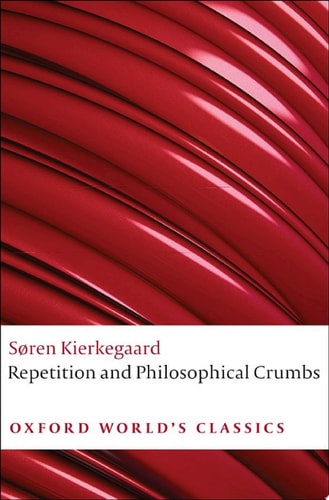
Repetition and Philosophical Crumbs
0
0
As an Amazon Associate and affiliate partner, Menrva Books earns from qualifying purchases. Learn more
Author Description
'The love of repetition is in truth the only happy love' So says Constantine Constantius on the first page of Kierkegaard's Repetition. Life itself, according to Kierkegaard's pseudonymous narrator, is a repetition, and in the course of this witty, playful work Constantius explores the nature of love and happiness, the passing of time and the importance of moving forward (and backward). The ironically entitled Philosophical Crumbs pursues the investigation of faith and love and their tense relationship with reason. Written only a year apart, these two works complement each other and give the reader a unique insight into the breadth and substance of Kierkegaard's thought. The first reads like a novel and the second like a Platonic dialogue, but both engage, in different ways, the same challenging issues. These are the first translations to convey the literary quality and philosophical precision of the originals. They were not intended, however, for philosophers, but for anyone who feels drawn to the question of the ultimate truth of human existence and the source of human happiness. ABOUT THE SERIES: For over 100 years Oxford World's Classics has made available the widest range of literature from around the globe. Each affordable volume reflects Oxford's commitment to scholarship, providing the most accurate text plus a wealth of other valuable features, including expert introductions by leading authorities, helpful notes to clarify the text, up-to-date bibliographies for further study, and much more.
Menrva's Summary
THE THESIS
These works investigate the fundamental nature of human existence, the paradoxes of faith, and the possibility of happiness through the lens of repetition and reason. Søren Kierkegaard, a foundational figure in existentialist thought, utilizes pseudonymous narrators to examine the tension between subjective experience and objective truth. Through these texts, he challenges the reader to confront the limitations of rationalism when applied to the complexities of love, faith, and the passage of time. The volume provides a structured inquiry into how individuals navigate the movement of life, both forward and backward, in search of meaning.
THE SCOPE MAP
What You Will Find
- An exploration of the concept of repetition as a mechanism for personal development and happiness.
- A critical analysis of the relationship between faith and reason in the context of human existence.
- Scholarly introductions and explanatory notes provided by Edward F. Mooney and M. G. Piety.
Scope Limits
- The text does not provide a systematic or comprehensive overview of Kierkegaard's entire philosophical corpus.
- It does not offer a simplified self-help methodology for achieving happiness, but rather a rigorous philosophical inquiry.
THE AUTHORITY PERSPECTIVE
Scholars and students of philosophy frequently cite this edition for its success in capturing the distinct literary styles of Kierkegaard's pseudonymous works. Experts highlight the volume as a primary resource for understanding the transition between Kierkegaard's more narrative-driven explorations and his formal dialectical inquiries.
Page Count:
224
Publication Date:
2009-01-01
Publisher:
OUP Oxford
ISBN-10:
0191607509
ISBN-13:
9780191607509
Philosophy
Non-Fiction
Existentialism
Classical Philosophy
History & Surveys
Community Tags
Similar Books