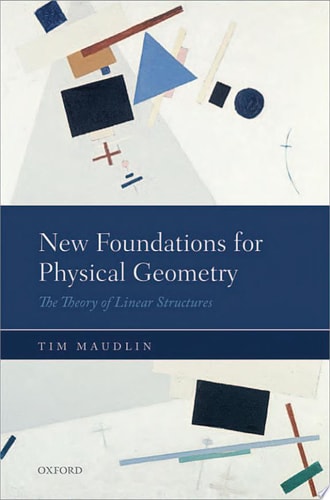
New Foundations for Physical Geometry: The Theory of Linear Structures
0
0
As an Amazon Associate and affiliate partner, Menrva Books earns from qualifying purchases. Learn more
Author Description
Topology Is The Mathematical Study Of The Most Basic Geometrical Structure Of A Space. Mathematical Physics Uses Topological Spaces As The Formal Means For Describing Physical Space And Time. This Book Proposes A Completely New Mathematical Structure For Describing Geometrical Notions Such As Continuity, Connectedness, Boundaries Of Sets, And So On, In Order To Provide A Better Mathematical Tool For Understanding Space-time. This Is The Initial Volume In A Two-volume Set, The First Of Which Develops The Mathematical Structure And The Second Of Which Applies It To Classical And Relativistic Physics. The Book Begins With A Brief Historical Review Of The Development Of Mathematics As It Relates To Geometry, And An Overview Of Standard Topology. The New Theory, The Theory Of Linear Structures, Is Presented And Compared To Standard Topology. The Theory Of Linear Structures Replaces The Foundational Notion Of Standard Topology, The Open Set, With The Notion Of A Continuous Line. Axioms For The Theory Of Linear Structures Are Laid Down, And Definitions Of Other Geometrical Notions Developed In Those Terms. Various Novel Geometrical Properties, Such As A Space Being Intrinsically Directed, Are Defined Using These Resources. Applications Of The Theory To Discrete Spaces (where The Standard Theory Of Open Sets Gets Little Purchase) Are Particularly Noted. The Mathematics Is Developed Up Through Homotopy Theory And Compactness, Along With Ways To Represent Both Affine (straight Line) And Metrical Structure.
Menrva's Summary
THE THESIS
This book investigates whether the standard topological framework of open sets is the most effective mathematical tool for describing the physical structure of space-time. Tim Maudlin, a philosopher of science, introduces the Theory of Linear Structures as a formal alternative to traditional topology. By replacing the open set with the continuous line as the foundational unit, the author constructs a new axiomatic system designed to better capture geometrical notions like continuity, connectedness, and boundaries in both continuous and discrete spaces.
THE SCOPE MAP
What You Will Find
- An axiomatic development of the Theory of Linear Structures
- A comparative analysis between linear structures and standard point-set topology
- Definitions for novel geometrical properties including intrinsically directed spaces
- Mathematical derivations extending through homotopy theory and compactness
Scope Limits
- This volume focuses primarily on the mathematical development of the theory rather than its full application to physical systems, which is reserved for the subsequent volume.
THE AUTHORITY PERSPECTIVE
Experts in the philosophy of physics and mathematical foundations recognize this work as a rigorous attempt to re-evaluate the formal tools used to describe space-time. Readers frequently note the technical density of the prose, which requires a strong background in topology and mathematical logic to fully appreciate the proposed shift in foundational axioms.
Page Count:
352
Publication Date:
2014-01-01
Publisher:
Oxford University Press
ISBN-10:
0191004553
ISBN-13:
9780191004551
Philosophy
Mathematical Physics
Space and time
Geometry
Philosophy of
Mathematics
Topology
Theoretical Physics
Community Tags
Other Editions(2)
Similar Books