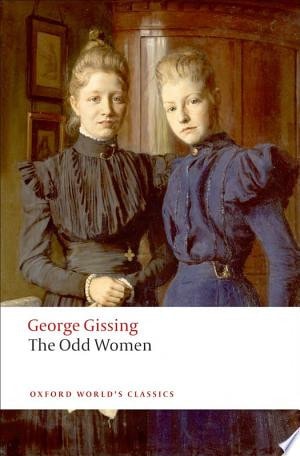
The Odd Women
0
0
As an Amazon Associate and affiliate partner, Menrva Books earns from qualifying purchases. Learn more
Author Description
'There are half a million more women than men in this unhappy country of ours... so many odd women - no making a pair with them.' The idea of the superfluity of unmarried women was one the 'New Woman' novels of the 1890s sought to challenge. But in The Odd Women (1893) Gissing satirizes the prevailing literary image of the 'New Woman' and makes the point that unmarried women were generally viewed less as noble and romantic figures than as 'odd' and marginal in relation to the ideal of womanhood itself. Set in grimy, fog-ridden London, these 'odd' women range from the idealistic, financially self-sufficient Mary Barfoot and Rhoda Nunn, who run a school to train young women in office skills for work, to the Madden sisters struggling to subsist in low-paid jobs and experiencing little comfort or pleasure in their lives. Yet it is for the youngest Madden sister's marriage that the novel reserves its most sinister critique. With superb detachment Gissing captures contemporary society's ambivalence towards its own period of transition. The Odd Women is a novel engaged with all the major sexual and social issues of the late-nineteenth century. Judged by contemporary reviewers as equal to Zola and Ibsen, Gissing was seen to have produced an 'intensely modern' work and it is perhaps for this reason that the issues it raises remain the subject of contemporary debate.
Menrva's Summary
THE PULSE
In late-nineteenth-century London, a surplus of unmarried women faces a society that views them as social anomalies rather than independent individuals. The narrative follows the lives of various women, from the ambitious, career-focused Mary Barfoot and Rhoda Nunn to the impoverished Madden sisters, as they navigate the rigid constraints of Victorian gender roles. Gissing employs a detached, observational framework to examine the economic and personal struggles of these women, contrasting their aspirations for autonomy against the prevailing societal pressure to marry. The story unfolds through a series of interconnected lives, highlighting the stark disparity between those who can secure financial independence and those trapped by systemic poverty and limited opportunity.
INSIDE THE PAGES
- Exploration of the 'New Woman' archetype within the 1890s social context
- Detailed depiction of the economic realities of working-class women in London
- Contrast between idealistic independence and the necessity of marriage
- Satirical critique of contemporary literary portrayals of femininity
- Examination of the psychological impact of social marginalization
- Focus on the transition of gender roles in late-Victorian society
- Realistic, often bleak, portrayal of urban living conditions
- Analytical approach to the intersection of class, gender, and labor
THE COLLECTIVE ECHO
Readers and critics frequently highlight Gissing's clinical, detached prose style as a defining feature of the work. Discussion often centers on the author's refusal to romanticize the plight of his characters, opting instead for a gritty, realistic assessment of their limited options. Many observers note that the novel remains relevant due to its nuanced exploration of autonomy and the social stigma attached to unmarried status. The balance between character-driven narrative and social commentary is often cited as a primary strength, providing a clear window into the anxieties of the era. Scholars frequently compare Gissing's impact to that of his contemporaries like Ibsen and Zola, noting his ability to capture the complexities of a society in flux.
Page Count:
432
Publication Date:
2000-01-01
Publisher:
Oup Oxford
ISBN-10:
0191587583
ISBN-13:
9780191587580
Historical Fiction
Classic Literature
Social Realism
Victorian
Feminist
Community Tags
Other Editions(15)

E-Artnow
2022
Default edition
Mint Editions
2021

West Margin Press
2021
Independently Published
2020

Woolf Haus Publishing
2020

Independently Published
2020

Amazon Digital Services LLC - KDP Print US
2019

CreateSpace Independent Publishing Platform
2017

CreateSpace Independent Publishing Platform
2017
CreateSpace Independent Publishing Platform
2016
Creative Media Partners, LLC
2016
CreateSpace Independent Publishing Platform
2013
Oup Oxford
2000
OUP Oxford
2000
W. W. Norton & Company
1977
Similar Books



Reader Comments
Share Your Thoughts
No comments yet. Be the first to share your thoughts!