Twilight of the Idols
0
0
As an Amazon Associate and affiliate partner, Menrva Books earns from qualifying purchases. Learn more
Author Description
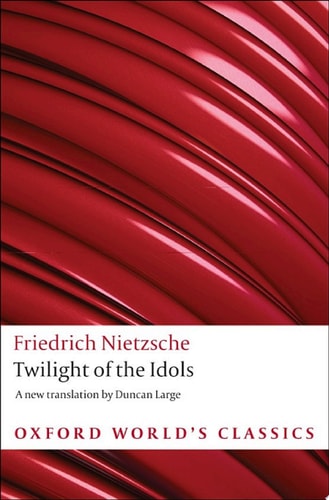
Nietzsche intended Twilight of the Idols to serve as a short introduction to the whole of his philosophy, and to be the most synoptic of all his books. A polemic, this 'great declaration of war' targets not only 'eternal idols' like Socratic rationality and Christian morality but also their contemporary counterparts, as Nietzsche the 'untimely man' goes roaming in the gloaming of nineteenth-century European culture. This translation is supplemented by a detailed commentary on one of Nietzsche's most condensed works. 'Anyone who wants to gain a quick idea of how before me everything was topsy-turvy should make a start with this work. That which is called idol on the title-page is quite simply that which was called truth hitherto. Twilight of the Idols - in plain words: the old truth is coming to an end...' Nietzsche intended Twilight of the Idols to serve as a short introduction to his philosophy, and as a result it is the most synoptic of all his books. Continuing in the spirit of its immediate predecessors On the Genealogy of Morals and The Wagner Case, it is a polemic, targeting not only 'eternal idols' like Socratic rationality and Christian morality but also their contemporary counterparts, as Nietzsche the 'untimely man' goes roaming in the gloaming of nineteenth-century European culture. He allies philosophy with psychology and physiology, relentlessly diagnosing the symptoms of decadence, and his stylistic virtuosity is such that the sheer delight he takes in his 'demonic' mischief-making communicates itself on every page. A translation, this edition provides detailed commentary on a highly condensed and allusive work.
Menrva's Summary
THE THESIS
Friedrich Nietzsche investigates the collapse of traditional Western values and the necessity of re-evaluating the foundations of truth, morality, and rationality. Nietzsche, a seminal figure in 19th-century philosophy, utilizes this text as a condensed, synoptic overview of his broader philosophical project. He argues that the 'idols' of the past—specifically Socratic rationalism and Christian morality—are symptoms of cultural decadence that must be dismantled to allow for a new understanding of human existence.
THE SCOPE MAP
What You Will Find
- A critique of Socratic and Christian moral frameworks
- An analysis of the intersection between philosophy, psychology, and physiology
- A diagnostic approach to identifying symptoms of cultural decline
Scope Limits
- The text does not provide a comprehensive or systematic treatise on all aspects of Nietzsche's thought
- It does not offer a detailed historical account of the figures it critiques, focusing instead on polemical deconstruction
THE AUTHORITY PERSPECTIVE
Scholars frequently identify this work as one of the most accessible entry points into Nietzsche's mature philosophy due to its aphoristic and condensed nature. Experts note that while the prose is highly polemical and stylistic, it remains a foundational text for understanding the author's critique of Western metaphysics.
Page Count:
176
Publication Date:
1998-01-01
Publisher:
Oxford University Press, Uk
ISBN-10:
0191588792
ISBN-13:
9780191588792
Philosophy
Non-Fiction
Polemic
Continental Philosophy
19th Century
Ethics
Community Tags
Similar Books