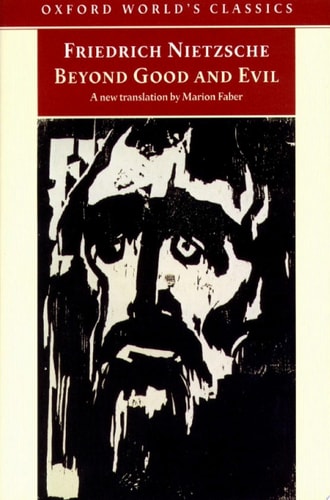
Beyond Good and Evil: Prelude to a Philosophy of the Future
0
0
As an Amazon Associate and affiliate partner, Menrva Books earns from qualifying purchases. Learn more
Author Description
What is done out of love always takes place beyond good and evil.' Always provocative, the Friedrich Nietzsche of Beyond Good and Evil (1886) is at once sceptical psychologist and philosopher-seer, passionately unmasking European society with his piercing insights and uncanny prescience. This masterpiece of his maturity considers quintessential Nietzschean topics such as the origins and nature of Judeo-Christian morality; the end of philosophical dogmatism and beginning of perspectivism; the questionable virtues of science and scholarship; liberal democracy, nationalism, and women's emancipation. Written in his most masterful style, full of irreverence and brio, Nietzsche dissects self-deluding human behaviour, bankrupt intellectual traditions, and the symptoms of social decadence, while at the same time advancing an extra-moral wisdom to be shared by those kindred soul who think 'beyond good and evil'. This new translation of Beyond Good and Evil provides readers with a true classic of modernity that sums up those forces and counterforces in nineteenth-century Western Civilisation that to an astonishing degree have also determined and continue to inform the course of our own century. ABOUT THE SERIES: For over 100 years Oxford World's Classics has made available the widest range of literature from around the globe. Each affordable volume reflects Oxford's commitment to scholarship, providing the most accurate text plus a wealth of other valuable features, including expert introductions by leading authorities, helpful notes to clarify the text, up-to-date bibliographies for further study, and much more.
Menrva's Summary
THE THESIS
This work investigates the validity of traditional moral systems and the dogmatic nature of Western philosophy, questioning the foundations of truth and human behavior. Friedrich Nietzsche, a German philosopher and cultural critic, utilizes his background in philology and his unique aphoristic style to dismantle the binary of good and evil. He argues that traditional morality is a construct that suppresses the human will to power and advocates for a new, perspectivist approach to understanding existence.
THE SCOPE MAP
What You Will Find
- Critique of Judeo-Christian morality and its historical origins
- Analysis of the decline of philosophical dogmatism
- Exploration of perspectivism as a replacement for objective truth
- Commentary on European nationalism, democracy, and social decadence
Scope Limits
- Does not provide a systematic or structured philosophical manual
- Does not offer a comprehensive political manifesto for governance
THE AUTHORITY PERSPECTIVE
Scholars and readers frequently note the dense, aphoristic nature of the prose, which requires careful interpretation. Experts highlight this text as a foundational work for understanding modern existentialism and the transition into post-structuralist thought.
Page Count:
240
Publication Date:
1998-01-01
Publisher:
OUP Oxford
ISBN-10:
0191605263
ISBN-13:
9780191605260
Philosophy
Non-Fiction
19th Century
Political Philosophy
Ethics
Western philosophy
Community Tags
Other Editions(4)


Similar Books





Reader Comments
Share Your Thoughts
No comments yet. Be the first to share your thoughts!