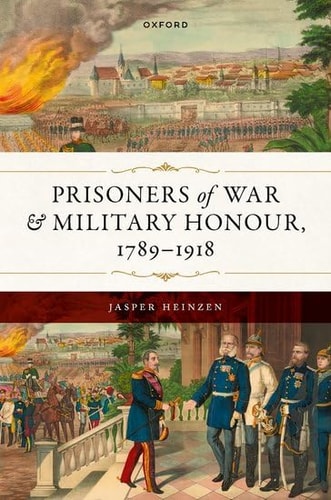
Prisoners of War and Military Honour, 1789–1918
0
0
As an Amazon Associate and affiliate partner, Menrva Books earns from qualifying purchases. Learn more
Author Description
Early in the modern period, prisoners of war with the rank of officer or equivalent had the right to petition for parole. By effectively pawning their personal honour, they were able to purchase freedom of movement and other privileges-in-captivity. Increasingly, other ranks and civilians claimed a right to parole too.Based on material from close to thirty Australian, British, Dutch, French, German, and Swiss archives, Jasper Heinzen investigates the role and implications of honour-based agreements between prisoners of war and their captors in western European warfare. Across a range of ego documents, ministerial memoranda, the minutes of Masonic lodges, and prisoners' petitions, as well as a substantial body of published material, he demonstrates how captives, statesmen, and humanitarians understood honour in the 'long nineteenth century', how they negotiated national differences, and why parole d'honneur continued to matter as a code of conduct into the First World War. In so doing, the book demonstrates the dichotomy between 'good' codes of conduct prevalent in the eighteenth century and the practices of modern warfare―perpetuated by a substantial amount of scholarship―to be a false one. Explaining the longevity of parole in this novel way raises important questions about the so-called 'military Enlightenment', the excesses of the world wars, total war, and the practices and codes of modern warfare.
Menrva's Summary
THE THESIS
This book investigates how the concept of honour-based parole functioned as a critical code of conduct for prisoners of war in western Europe between 1789 and 1918. Jasper Heinzen, a historian specializing in modern European warfare, utilizes a vast array of archival documents to challenge the traditional academic dichotomy between the perceived chivalry of eighteenth-century warfare and the total war practices of the twentieth century. He argues that the parole system remained a persistent and significant mechanism for managing captivity, reflecting evolving national identities and humanitarian standards throughout the long nineteenth century.
THE SCOPE MAP
What You Will Find
- Analysis of parole d'honneur practices across British, French, German, Dutch, and Swiss military systems.
- Examination of ego documents, ministerial memoranda, and Masonic lodge records.
- Investigation into the transition of parole rights from officers to other ranks and civilians.
Scope Limits
- The study focuses primarily on western European warfare and does not provide an exhaustive global history of prisoner treatment.
- The analysis concludes with the First World War and does not extend into the mid-twentieth-century developments of international prisoner conventions.
THE AUTHORITY PERSPECTIVE
Scholars recognize this work as a significant contribution to the history of military ethics and the evolution of international law. Readers frequently note the academic density of the prose and the extensive archival research that supports the author's revisionist arguments.
Page Count:
368
Publication Date:
2025-05-06
Publisher:
Oxford University Press
ISBN-10:
0192871161
ISBN-13:
9780192871169
History
European History
Prisoners of War
Ethics
Military History
19th Century
Europe
Warfare
Community Tags
Similar Books