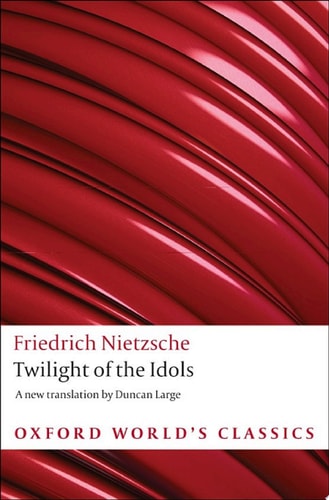
Twilight of the Idols: Or How to Philosophize with a Hammer
0
0
As an Amazon Associate and affiliate partner, Menrva Books earns from qualifying purchases. Learn more
Author Description
Anyone who wants to gain a quick idea of how before me everything was topsy-turvy should make a start with this work. That which is called idol on the title-page is quite simply that which was called truth hitherto. Twilight of the Idols - in plain words: the old truth is coming to an end...' Nietzsche intended Twilight of the Idols to serve as a short introduction to his philosophy, and as a result it is the most synoptic of all his books. Continuing in the spirit of its immediate predecessors On The Genealogy of Morals and The Wagner Case, it is a masterpiece of polemic, targeting not only `eternal idols' like Socratic rationality and Christian morality but also their contemporary counterparts, as Nietzsche the `untimely man' goes roaming in the gloaming of nineteenth-century European culture. He allies philosophy with psychology and physiology, relentlessly diagnozing the symptoms of decadence, and his stylistic virtuosity is such that the sheer delight he takes in his 'demonic' mischief-making communicates itself on every page. A brilliant new translation, this edition provides detailed commentary on a highly condensed and allusive work. ABOUT THE SERIES: For over 100 years Oxford World's Classics has made available the widest range of literature from around the globe. Each affordable volume reflects Oxford's commitment to scholarship, providing the most accurate text plus a wealth of other valuable features, including expert introductions by leading authorities, helpful notes to clarify the text, up-to-date bibliographies for further study, and much more.
Menrva's Summary
THE THESIS
This work investigates the collapse of traditional metaphysical truths and the necessity of re-evaluating the foundational values of Western civilization. Friedrich Nietzsche, a seminal figure in existentialist thought, utilizes this text to provide a condensed overview of his philosophical project. He argues that established moral and rational systems are symptoms of cultural decadence, proposing a shift toward a philosophy that integrates psychological and physiological insights to challenge the status quo.
THE SCOPE MAP
What You Will Find
- A critique of Socratic rationality and Christian morality.
- An analysis of nineteenth-century European cultural decadence.
- A methodological approach to philosophy as a form of psychological diagnosis.
Scope Limits
- The text does not provide a comprehensive systematic treatise of Nietzsche's entire body of work.
- It does not offer a neutral historical survey, as it is explicitly polemical in nature.
THE AUTHORITY PERSPECTIVE
Scholars frequently identify this text as an accessible entry point into Nietzsche's mature thought due to its synoptic nature. Readers often note the density of the prose and the necessity of the provided scholarly commentary to navigate the author's highly allusive style.
Page Count:
176
Publication Date:
1998-01-01
Publisher:
OUP Oxford
ISBN-10:
0191605174
ISBN-13:
9780191605178
Philosophy
Non-Fiction
19th Century
Continental Philosophy
History & Surveys
Classical Philosophy
Community Tags
Similar Books