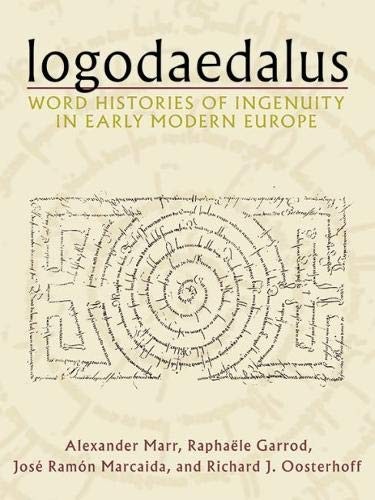
Logodaedalus
0
0
As an Amazon Associate and affiliate partner, Menrva Books earns from qualifying purchases. Learn more
Author Description
Before Romantic genius, there was ingenuity. Early modern ingenuity defined every person--not just exceptional individuals--as having their own attributes and talents, stemming from an "inborn nature" that included many qualities, not just intelligence. Through ingenuity and its family of related terms, early moderns sought to understand and appreciate differences between peoples, places, and things in an attempt to classify their ingenuities and assign professions that were best suited to one's abilities. Logodaedalus, a prehistory of genius, explores the various ways this language of ingenuity was defined, used, and manipulated between 1470 and 1750. By analyzing printed dictionaries and other lexical works across a range of languages--Latin, Italian, Spanish, French, English, German, and Dutch--the authors reveal the ways in which significant words produced meaning in history and found expression in natural philosophy, medicine, natural history, mathematics, mechanics, poetics, and artistic theory.
Menrva's Summary
THE THESIS
The concept of 'ingenuity' served as a precursor to modern notions of genius, defining individuals by their unique attributes and talents rather than solely by intelligence. This book traces the evolution and application of this language of ingenuity from 1470 to 1750, examining how early modern thinkers used it to understand and appreciate differences between people, places, and things. By analyzing lexical works in multiple languages, the study reveals how the meaning of 'ingenuity' was shaped and manipulated across various fields, including natural philosophy, medicine, mathematics, and artistic theory, ultimately laying the groundwork for later concepts of individual genius.
THE SCOPE MAP
- Analysis of printed dictionaries and lexical works across Latin, Italian, Spanish, French, English, German, and Dutch.
- Exploration of the term 'ingenuity' and its related concepts as a prehistory of genius.
- Examination of how 'ingenuity' was used to classify peoples, places, and professions based on inherent abilities.
- Investigation into the manipulation and definition of the language of ingenuity between 1470 and 1750.
- Discussion of the expression of ingenuity in natural philosophy, medicine, natural history, mathematics, mechanics, poetics, and artistic theory.
THE AUTHORITY PERSPECTIVE
The book examines the historical concept of 'ingenuity' as a precursor to modern ideas of genius, analyzing its usage across various European languages and academic disciplines during the early modern period. The scope of the research, focusing on lexical analysis and its application in fields from natural philosophy to poetics, suggests a dense, scholarly work. It likely appeals to academics and students of intellectual history, linguistics, and the history of science and art.
Page Count:
352
Publication Date:
2019-01-01
ISBN-10:
082294541X
ISBN-13:
9780822945413
Science
Non-Fiction
History
Linguistics
Intellectual History
Community Tags
Similar Books