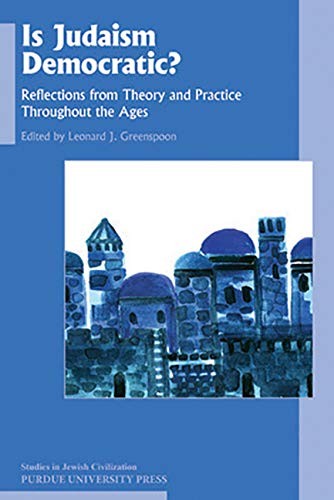
Is Judaism Democratic?
0
0
As an Amazon Associate and affiliate partner, Menrva Books earns from qualifying purchases. Learn more
Author Description
As government by the people, democracy has always had its proponents as well as opponents. What forms of government have Jewish leaders, both with and without actual political power, favored? Not surprisingly, many options have been offered theoretically and in practice. Perhaps more surprisingly, democracy has been at the heart of most systems of governance. Biblical Israel was largely a monarchy, but many writers of the Bible were critical of the excesses that almost always arise when human kings take charge: the general populace loses its freedom. In rabbinic Judaism, the majority ruled, and many principles that support modern democratic institutions have their basis in interpretations offered by the classical rabbis. This is true even though rabbinic Jews did not govern democratically. When Jews did have some degree of self-governance, democratic principles and institutions were often upheld. At the same time, so most communal leaders insisted, God--the ultimate judge--ultimately judges everything and everyone. Modern Israel provides the first instance of an independent Jewish nation since the Hasmonean monarchy of the second and first centuries BCE. On an almost daily basis, common features uniting democracy and Judaism, as well as flash point of controversy, are highlighted there. The fourteen scholars whose work is collected here are mindful of all of these circumstances--and many more. In a style that is accessible, clear, and balanced, they allow readers to assess these issues based on the most current thinking. This volume is required reading for anyone interested in how religion and politics have interacted, and continue to interact, in Judaism and among Jews
Menrva's Summary
THE THESIS
This book investigates the complex and often paradoxical relationship between Judaism and democratic principles throughout history and in contemporary times. The collection explores how Jewish leaders and texts have engaged with various forms of governance, from biblical critiques of monarchy to rabbinic Judaism's emphasis on majority rule and the modern State of Israel. It examines instances where democratic principles were upheld during periods of Jewish self-governance, while also acknowledging the overarching belief in divine judgment. The scholars present current thinking in an accessible, clear, and balanced style, allowing readers to assess the ongoing interaction between religion and politics within Judaism.
THE SCOPE MAP
- Exploration of Jewish perspectives on governance from biblical times to the present.
- Analysis of rabbinic Judaism's principles supporting modern democratic institutions.
- Examination of Jewish self-governance and its relationship with democratic principles.
- Discussion of Modern Israel as a case study for democracy and Judaism.
- Inclusion of work by fourteen scholars offering diverse viewpoints.
- Accessible, clear, and balanced presentation of complex issues.
- Focus on the interaction between religion and politics in Judaism.
THE AUTHORITY PERSPECTIVE
This volume is presented as essential reading for anyone interested in the intersection of religion and politics within Judaism. The collection of essays by fourteen scholars aims to provide a balanced and accessible overview of how democratic ideals have been understood and implemented, or debated, within Jewish history and thought. The book is structured to allow readers to form their own conclusions based on current scholarship. Its approach is designed to illuminate both the unifying features and points of contention between Judaism and democracy, particularly in the context of modern Israel.
Page Count:
266
Publication Date:
2018-01-01
ISBN-10:
1557538336
ISBN-13:
9781557538338
History
Politics
Non-Fiction
Judaism
Religion and Politics
Community Tags
Similar Books