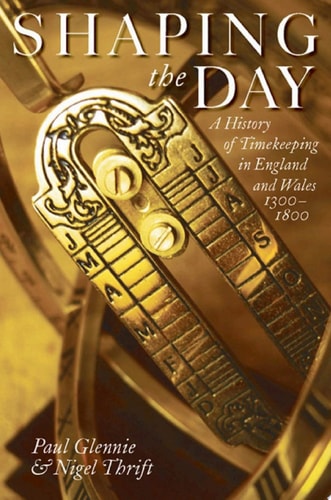
Shaping the Day: A History of Timekeeping in England and Wales 1300-1800
0
0
As an Amazon Associate and affiliate partner, Menrva Books earns from qualifying purchases. Learn more
Author Description
Timekeeping is an essential activity in the modern world, and we take it for granted that our lives are shaped by the hours of the day. Yet what seems so ordinary today is actually the extraordinary outcome of centuries of technical innovation and circulation of ideas about time. Shaping the Day is a pathbreaking study of the practice of timekeeping in England and Wales between 1300 and 1800. Drawing on many unique historical sources, ranging from personal diaries to housekeeping manuals, Paul Glennie and Nigel Thrift illustrate how a particular kind of common sense about time came into being, and how it developed during this period. Many remarkable figures make their appearance, ranging from the well-known, such as Edmund Halley, Samuel Pepys, and John Harrison, who solved the problem of longitude, to less familiar characters, including sailors, gamblers, and burglars. Overturning many common perceptions of the past-for example, that clock time and the industrial revolution were intimately related-this unique historical study will engage all readers interested in how 'telling the time' has come to dominate our way of life.
Menrva's Summary
THE THESIS
This book investigates how the modern, standardized perception of time emerged as a social practice in England and Wales between 1300 and 1800. Paul Glennie and Nigel Thrift, both distinguished scholars in geography and social theory, utilize a diverse array of primary sources—including personal diaries, housekeeping manuals, and administrative records—to challenge the conventional narrative that clock time was merely a byproduct of the Industrial Revolution. Their argument posits that the regulation of daily life through timekeeping was a gradual, complex cultural development involving a wide spectrum of society, rather than a sudden technological imposition.
THE SCOPE MAP
What You Will Find
- Analysis of timekeeping practices in England and Wales from 1300 to 1800.
- Examination of historical figures including Edmund Halley, Samuel Pepys, and John Harrison.
- Integration of social history with the history of technology and horology.
- Evidence derived from personal diaries, housekeeping manuals, and legal records.
Scope Limits
- The study focuses specifically on England and Wales, excluding broader global or continental European developments.
- It does not provide a technical manual on the mechanics of clock construction.
THE AUTHORITY PERSPECTIVE
Experts recognize this work as a significant contribution to the social history of time, noting its success in decoupling the history of clocks from the history of industrialization. Readers frequently observe that the prose is academically rigorous and dense, making it a specialized text for historians and sociologists interested in the evolution of modern temporal consciousness.
Page Count:
479
Publication Date:
2009-01-01
Publisher:
OUP Oxford
ISBN-10:
0191608521
ISBN-13:
9780191608520
History
Social History
Technology
European History
Time
Clocks And Watches
Cultural History
British History
Timekeeping