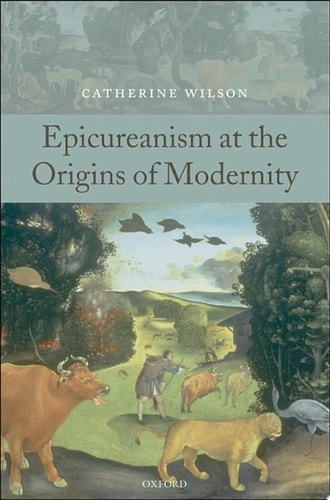
Epicureanism at the Origins of Modernity
0
0
As an Amazon Associate and affiliate partner, Menrva Books earns from qualifying purchases. Learn more
Author Description
This landmark study examines the role played by the rediscovery of the writings of the ancient atomists, Epicurus and Lucretius, in the articulation of the major philosophical systems of the seventeenth century, and, more broadly, their influence on the evolution of natural science and moral and political philosophy. The target of sustained and trenchant philosophical criticism by Cicero, and of opprobrium by the Christian Fathers of the early Church, for its unflinching commitment to the absence of divine supervision and the finitude of life, the Epicurean philosophy surfaced again in the period of the Scientific Revolution, when it displaced scholastic Aristotelianism. Both modern social contract theory and utilitarianism in ethics were grounded in its tenets. Catherine Wilson shows how the distinctive Epicurean image of the natural and social worlds took hold in philosophy, and how it is an acknowledged, and often unacknowledged presence in the writings of Descartes, Gassendi, Hobbes, Boyle, Locke, Leibniz, Berkeley. With chapters devoted to Epicurean physics and cosmology, the corpuscularian or "mechanical" philosophy, the question of the mortality of the soul, the grounds of political authority, the contested nature of the experimental philosophy, sensuality, curiosity, and the role of pleasure and utility in ethics, the author makes a persuasive case for the significance of materialism in seventeenth-century philosophy without underestimating the depth and significance of the opposition to it, and for its continued importance in the contemporary world. Lucretius's great poem, On the Nature of Things, supplies the frame of reference for this deeply-researched inquiry into the origins of modern philosophy..
Menrva's Summary
THE THESIS
This study investigates how the rediscovery of ancient Epicurean atomism served as a foundational catalyst for the development of seventeenth-century philosophical systems and the emergence of modern scientific thought. Catherine Wilson, a scholar of early modern philosophy, utilizes historical analysis and textual examination to demonstrate how Epicurean materialism challenged scholastic Aristotelianism. She argues that the shift toward a mechanical view of the universe and the rise of social contract theory were deeply indebted to the atomistic principles found in the works of Epicurus and Lucretius.
THE SCOPE MAP
What You Will Find
- Analysis of the transition from scholastic Aristotelianism to mechanical philosophy.
- Examination of Epicurean influence on thinkers including Descartes, Hobbes, Locke, and Leibniz.
- Exploration of the intersection between Epicurean physics, political authority, and utilitarian ethics.
Scope Limits
- The text focuses primarily on the seventeenth-century reception of atomism rather than a comprehensive history of ancient Epicureanism itself.
- It does not provide a general survey of all modern philosophy, concentrating instead on the specific lineage of materialist thought.
THE AUTHORITY PERSPECTIVE
Scholars recognize this work as a rigorous and detailed examination of the intellectual currents that shaped the Scientific Revolution. Readers frequently note the academic density of the prose, which provides a comprehensive account of how ancient materialism informed the development of modern political and scientific frameworks.
Page Count:
316
Publication Date:
2008-01-01
Publisher:
OUP Oxford
ISBN-10:
0191608157
ISBN-13:
9780191608155
Philosophy
Ethics
History & Surveys
Materialism
Seventeenth Century
Intellectual History
Science History