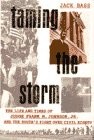
Taming the Storm
0
0
As an Amazon Associate and affiliate partner, Menrva Books earns from qualifying purchases. Learn more
Author Description
In 1955, the same year Rosa Parks refused to give up her seat on a Montgomery, Alabama, city bus to a white man, President Eisenhower brought down from the hills of northwest Alabama a young U.S. attorney to sit as a federal District Court judge in Montgomery. His name was Frank M. Johnson, Jr., and at thirty-seven he was the youngest federal judge in the country. Thrust by fate into the center of a raging storm of controversy, this quietly determined judge would turn the tide of white resistance to integration with a stream of decisions that upheld the claims of black Southerners to their civil rights. In his twenty-four years on the District Court, Judge Johnson declared segregated public transportation unconstitutional, ordered the integration of public facilities, and required that blacks be registered to vote. He ordered Governor George Wallace, his former law school classmate, to allow the civil rights march from Selma to Montgomery and brought about comprehensive statewide school desegregation. His precedent-setting decisions extended to discrimination against women, rights of prison inmates, and the right of patients in mental institutions to treatment. Judge Johnson paid heavily for his judicial vision. Ostracized from his community, subjected to death threats by the Ku Klux Klan, and labeled by George Wallace as "an integrating, scalawagging, carpet bagging, race mixing, bald faced. Liar who should be given "a barbed-wire enema," he was called by some "the most hated man in the South." In 1967 his mother's house was bombed in the belief that it was his. Despite it all, he did not waver in administering justice by applying his concept of the Constitution as a charter of liberty. Martin Luther King, Jr., called him a man who "gave true meaning to the word justice." Judge Frank Johnson endured the outrage of a society that felt itself and its values. Under siege, and he prevailed, eventually winning honor even in his home state. Taming the Storm is the
Menrva's Summary
THE THESIS
This book chronicles the life and judicial career of Frank M. Johnson, Jr., a federal judge who presided over pivotal civil rights cases in the American South during the mid-20th century. Facing intense opposition and personal threats, Johnson's landmark decisions shaped the course of desegregation and civil rights for African Americans and advanced protections for other marginalized groups. The narrative explores his quiet determination and unwavering commitment to justice despite immense societal pressure and danger.
THE SCOPE MAP
- The early life and legal career of Frank M. Johnson, Jr., including his appointment as the youngest federal District Court judge in Montgomery, Alabama.
- Detailed accounts of Johnson's key rulings on desegregated public transportation, integration of public facilities, and voter registration for Black Southerners.
- The legal battles and political confrontations Johnson faced, including his orders to Governor George Wallace regarding the Selma to Montgomery march and statewide school desegregation.
- Examination of Johnson's precedent-setting decisions on discrimination against women and the rights of prison inmates and patients in mental institutions.
- The personal cost of Johnson's judicial vision, including ostracism, death threats from the Ku Klux Klan, and public condemnation.
- The eventual recognition and honor Johnson received, even within his home state, for his contributions to justice and civil rights.
THE AUTHORITY PERSPECTIVE
This biography is recognized for its in-depth exploration of a crucial figure in the Civil Rights Movement, highlighting Judge Frank M. Johnson, Jr.'s pivotal role in dismantling segregation through his judicial decisions. It details the significant personal and professional challenges he faced due to his progressive rulings, including threats from extremist groups and political opposition. The book is noted for its comprehensive account of his legal legacy, which extended beyond racial discrimination to include issues of women's rights and institutional reform, ultimately portraying him as a courageous advocate for justice.
Page Count:
0
Publication Date:
1994-01-01
ISBN-10:
0385413491
ISBN-13:
9780385413497
History
Non-Fiction
Biography
Civil Rights
Legal History
Community Tags
Similar Books