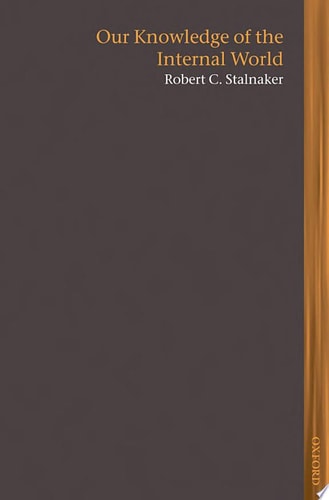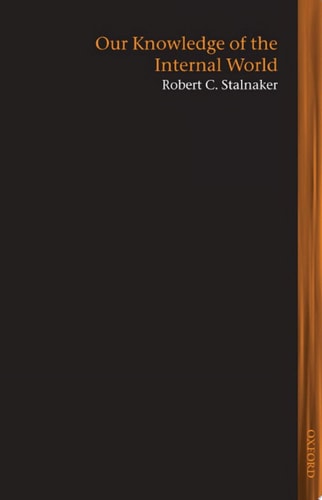
Our Knowledge of the Internal World
0
0
As an Amazon Associate and affiliate partner, Menrva Books earns from qualifying purchases. Learn more
Author Description
On the traditional Cartesian picture, knowledge of one's own internal world -- of one's current thoughts and feelings -- is the unproblematic foundation for all knowledge. The philosophical problem is to explain how we can move beyond this knowledge, how we can form a conception of an objective world, and how we can know that the world answers to our conception of it. This book is in the anti-Cartesian tradition that seeks to reverse the order of explanation. Robert Stalnaker argues that we can understand our knowledge of our thoughts and feelings only by viewing ourselves from the outside, and by seeing our inner lives as features of the world as it is in itself. He uses the framework of possible worlds both to articulate a conception of the world as it is in itself, and to represent the relation between our objective knowledge and our knowledge of our place in the world. He explores an analogy between knowledge of one's own phenomenal experience and self-locating knowledge -- knowledge of who one is, and what time it is. He criticizes the philosopher's use of the notion of acquaintance to characterize our intimate epistemic relation to the phenomenal character of our experience, and explores the tension between an anti-individualist conception of the contents of thought and the thesis that we have introspective access to that content. The conception of knowledge that emerges is a contextualist and anti-foundationalist one but, it is argued, a conception that is compatible with realism about both the external and internal worlds.
Menrva's Summary
THE THESIS
This book investigates the core philosophical problem of how we can understand our knowledge of our own internal thoughts and feelings by reversing the traditional Cartesian order of explanation. Robert C. Stalnaker, a prominent philosopher of language and mind, utilizes a framework of possible worlds to argue that inner life should be viewed as a feature of the external world. He challenges the foundationalist view that self-knowledge is the starting point for all other knowledge, proposing instead an anti-foundationalist and contextualist perspective that maintains realism regarding both internal and external domains.
THE SCOPE MAP
What You Will Find
- A framework of possible worlds applied to self-locating knowledge.
- An analysis of the analogy between phenomenal experience and self-locating knowledge.
- A critique of the concept of acquaintance in epistemic relations.
- An exploration of the tension between anti-individualist thought content and introspective access.
Scope Limits
- The text does not provide a comprehensive history of Cartesian philosophy.
- It does not offer a practical guide for psychological self-help or therapy.
THE AUTHORITY PERSPECTIVE
Experts and scholars in the field of analytic philosophy recognize this work as a significant contribution to the debate on self-knowledge and the philosophy of mind. Readers frequently note the high level of academic density and the rigorous, technical nature of the prose, which is intended for an audience familiar with contemporary epistemological discourse.
Page Count:
172
Publication Date:
2010-01-01
Publisher:
OUP Oxford
ISBN-10:
0191615536
ISBN-13:
9780191615535
Philosophy
Metaphysics
Knowledge Theory
Epistemology
Philosophy of