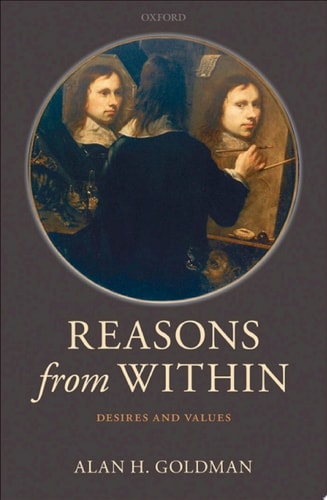
Reasons from Within: Desires and Values
0
0
As an Amazon Associate and affiliate partner, Menrva Books earns from qualifying purchases. Learn more
Author Description
Do the reasons we have for acting as we do derive from our concerns and desires, or are there objective values in the world that we are rationally required to pursue and protect? Alan H. Goldman argues for the internalist or subjectivist view of practical reasons on the grounds that it is simpler, more unified, and more comprehensible than the rival objectivist position. He provides a naturalistic account of practical rationality in terms of coherence within sets of desires or motivational states, and between motivations, intentions, and actions. Coherence is defined as the avoidance of self-defeat, the defeat of one's own deepest concerns. The demand for coherence underlies both practical and theoretical reason and derives from the natural aims of belief and action. In clarifying which desires create reasons, drawing on the literature of cognitive psychology, Goldman offers conceptual analyses of desires, emotions, and attitudes. Reasons are seen to derive ultimately from our deepest occurrent concerns. These concerns require no reasons themselves but provide reasons for many more superficial desires. In defense of this theory, Goldman argues that rational agents need not be morally motivated or concerned for their narrow self-interest. Objective values would demand such concern. They would be independent of our desires but would provide reasons for us to pursue and protect them. They would require rational agents to be motivated by them. But, Goldman argues, we are not motivated in that way, and it makes no sense to demand that our informed and coherent desires be generally other than they are. We need not appeal to such objective values in order to explain how our lives can be good and meaningful. Reasons from Within will appeal to anyone interested in the nature of values and reasons, particularly students of philosophy, psychology, and decision theory.
Menrva's Summary
THE THESIS
This work investigates whether practical reasons for action originate from internal desires and concerns or from objective values existing independently of the agent. Alan H. Goldman, a philosopher specializing in ethics and rationality, utilizes a naturalistic framework to argue for internalism. He posits that practical rationality is defined by the coherence of an individual's motivational states, intentions, and actions, rather than adherence to external moral imperatives.
THE SCOPE MAP
What You Will Find
- A naturalistic theory of practical rationality based on internal coherence.
- Conceptual analysis of desires, emotions, and attitudes informed by cognitive psychology.
- A critique of objectivist theories of value and moral motivation.
Scope Limits
- The text does not provide a comprehensive guide to applied ethics or specific moral decision-making.
- It does not address theological or metaphysical foundations of objective value.
THE AUTHORITY PERSPECTIVE
Philosophical scholars recognize this text as a rigorous defense of internalist metaethics that bridges the gap between decision theory and psychology. Readers frequently note the academic density of the prose, which is intended for advanced students and professionals in the field.
Page Count:
286
Publication Date:
2009-01-01
Publisher:
OUP Oxford
ISBN-10:
0191610364
ISBN-13:
9780191610363
Philosophy
Ethics
Desire
Cognitive Psychology
Values
Decision Theory
Metaethics
Community Tags
Similar Books