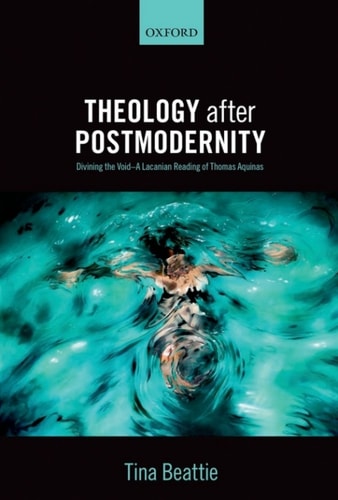
Theology after Postmodernity: Divining the Void—A Lacanian Reading of Thomas Aquinas
0
0
As an Amazon Associate and affiliate partner, Menrva Books earns from qualifying purchases. Learn more
Author Description
Theology after Postmodernity is a ground-breaking study that has the capacity to transform the relationship between psychoanalytic theory and Christian theology. Reading the theology of Thomas Aquinas in close engagement with the psychoanalytic theory of Jacques Lacan, Tina Beattie shows how Thomism exerted a formative influence on Lacan, and she also shows how a Lacanian approach can bring rich new insights to Thomas's theology. A growing number of English-speaking scholars now recognize the extent to which twentieth century French theorists and philosophers were influenced by medieval theology, and there have been several studies of Jacques Lacan's Thomism. However, this is the first study published in English to bring a Lacanian feminist perspective to bear on the theology of Thomas Aquinas. Focusing on the centrality of desire in Thomas's theology and Lacan's psychoanalytic theory, Beattie follows Lacan along an overgrown and often hidden path through the changing configurations of desire, gender, and knowledge from their Aristotelian formation in the medieval universities to their fragmentation in the collapse of modernity's visions and values. Beattie offers a penetrating critique of Thomas's Aristotelianism, but she also excavates the mystical treasures within his theology. This enables her to show how Thomas's God remains an unconscious but potent influence in the shaping of modern western thought, and to ask what transformations might be needed in order to bring about a Thomism for our times. Probing beneath the surface of Thomas's Summa Theologiae and other writings, she brings to light the Other of Thomas's One God - an incarnate, maternal Trinity who emerges when Thomas's Aristotelian ontotheology is suspended and the more neglected aspects of his doctrinal and theological insights are allowed to emerge. Lacan makes possible a renewed Thomism which offers a rich theology of creation, incarnation, and redemption capable of responding to some of the most u
Menrva's Summary
THE THESIS
This study investigates the intersection of medieval theology and modern psychoanalytic theory by examining the influence of Thomas Aquinas on the work of Jacques Lacan. Tina Beattie, a scholar of theology and gender, utilizes a Lacanian feminist framework to re-evaluate the Summa Theologiae. She argues that the concept of desire serves as a bridge between Thomistic metaphysics and psychoanalytic inquiry, ultimately proposing a renewed vision of Thomism that addresses contemporary concerns regarding creation, incarnation, and gender.
THE SCOPE MAP
What You Will Find
- A comparative analysis of Thomistic Aristotelianism and Lacanian psychoanalytic theory.
- An exploration of the role of desire, gender, and knowledge in medieval and modern thought.
- A critical reading of the Summa Theologiae through the lens of the unconscious.
Scope Limits
- The text does not provide a comprehensive history of medieval philosophy.
- It does not offer a general introduction to Lacanian psychoanalysis for non-specialists.
THE AUTHORITY PERSPECTIVE
Scholars recognize this work as a significant contribution to the dialogue between continental philosophy and Christian theology. Readers frequently note the academic density of the prose, which requires a foundational understanding of both Lacanian terminology and scholastic theology to fully navigate.
Page Count:
448
Publication Date:
2013-01-01
Publisher:
OUP Oxford
ISBN-10:
0191611832
ISBN-13:
9780191611834
Philosophy
Religion
Theology
Psychoanalysis
Feminist Theory
Community Tags
Similar Books