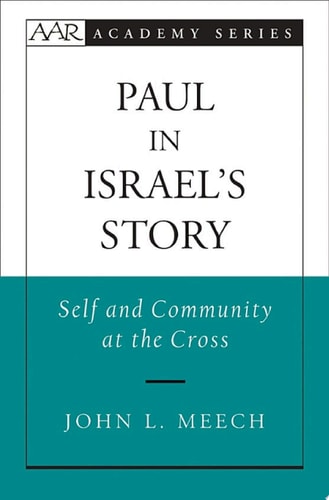
Paul in Israel's Story: Self and Community at the Cross
0
0
As an Amazon Associate and affiliate partner, Menrva Books earns from qualifying purchases. Learn more
Author Description
It is commonplace that postmodern thought has problematized the concept of the self. This poses a particularly sharp problem for Christian theologians, for whom the idea of the person as a Christian self must be central. In this book John Meech addresses this problem by means of a theological hermeneutics that brings together cutting edge scholarship in biblical interpretation and constructive theology. The book comprises three major parts. In the first, Meech reflects on St. Paul's construal of Christian identity in light of what has become known as the "new paradigm" in Pauline studies. This movement, identified with N.T. Wright, James Dunn, and Terence Donaldson, stresses the communal aspects of Paul's thought and his narrative understanding of the self. In the second part, Meech offers a pivotal analysis of Rudolf Bultmann's phenomenology of the self and its impact on his demythologizing interpretation of Paul's writings. In the third part, Meech engages Paul Ricoeur's late work, Oneself as Another, as a guide to the postmodern problem of selfhood and as a heuristic resource for interpreting Paul's writings. He does not restrict himself to a textual treatment of Ricoeur's work on selfhood and narrative, nor does he stop at an abstract reflection on its significance for theology. Instead he explores in considerable detail the contributions and implications of Ricoeur's later writings for biblical hermeneutics and theology. Investigating the unthematized hints about community presupposed in Ricoeur's work, Meech reconfigures his ontology of the self as an ontology of the self in community. Finally, he correlates Paul's communal understanding of the "I" with this ontology, articulating a self that is constituted in community but not reduced to a mere locus of community. He argues that the community posited in his study can be understood as the community of the living and dead in Christ.
Menrva's Summary
THE THESIS
How can the concept of the Christian self be reconciled with postmodern critiques that challenge the stability of individual identity? John L. Meech utilizes a theological hermeneutics framework to bridge contemporary biblical scholarship with constructive theology. By synthesizing Pauline studies, Bultmann’s phenomenology, and the philosophy of Paul Ricoeur, the author argues for an ontology of the self that is fundamentally constituted within a community of faith.
THE SCOPE MAP
What You Will Find
- Analysis of the "new paradigm" in Pauline studies, including the work of N.T. Wright and James Dunn.
- Critical examination of Rudolf Bultmann’s phenomenology and demythologizing approach.
- Application of Paul Ricoeur’s late philosophical work, specifically Oneself as Another.
- A proposed model of the self as a participant in the community of the living and the dead in Christ.
Scope Limits
- The text does not provide a general introduction to Pauline theology for lay readers.
- It does not offer a comprehensive survey of all postmodern philosophical critiques of the self.
THE AUTHORITY PERSPECTIVE
Scholars and students of theology frequently note the academic density of the prose and the rigorous interdisciplinary nature of the argument. Experts highlight this as a significant contribution to the intersection of continental philosophy and biblical hermeneutics.
Page Count:
192
Publication Date:
2006-01-01
Publisher:
Oxford University Press
ISBN-10:
0190294477
ISBN-13:
9780190294472
Religion
Philosophy
Hermeneutics
Theology
Christianity
Community Tags
Similar Books