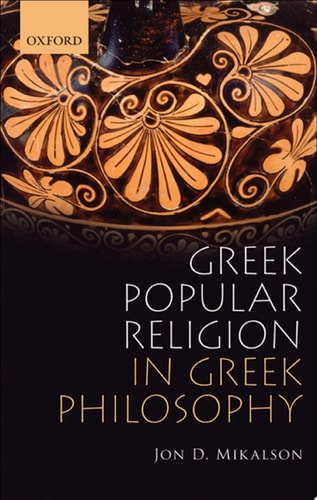
Greek Popular Religion in Greek Philosophy
0
0
As an Amazon Associate and affiliate partner, Menrva Books earns from qualifying purchases. Learn more
Author Description
Jon D. Mikalson examines how Socrates, Plato, Aristotle, and other Greek philosophers described, interpreted, criticized, and utilized the components and concepts of the religion of the people of their time - practices such as sacrifice, prayer, dedications, and divination. The chief concepts involved are those of piety and impiety, and after a thorough analysis of the philosophical texts Mikalson offers a refined definition of Greek piety, dividing it into its two constituent elements of `proper respect' for the gods and `religious correctness'. He concludes with a demonstration of the benevolence of the gods in the philosophical tradition, linking it to the expectation of that benevolence evinced by popular religion.
Menrva's Summary
THE THESIS
This work investigates the complex intersection between the established practices of Greek popular religion and the critical interpretations offered by major classical philosophers. Jon D. Mikalson, a scholar of Greek religion, utilizes a rigorous analysis of primary philosophical texts to determine how thinkers like Socrates, Plato, and Aristotle engaged with common religious rituals. He argues that these philosophers did not merely reject popular belief but sought to redefine piety through the dual lenses of proper respect and religious correctness.
THE SCOPE MAP
What You Will Find
- Analysis of religious practices including sacrifice, prayer, and divination.
- A refined definition of piety within the philosophical tradition.
- Examination of the perceived benevolence of the gods.
Scope Limits
- The text focuses primarily on the philosophical interpretation of religion rather than the sociological study of the common people themselves.
- It does not provide an exhaustive history of all Greek cultic practices outside of those mentioned in the philosophical corpus.
THE AUTHORITY PERSPECTIVE
Scholars frequently cite this work as a foundational text for understanding the intellectual tension between traditional Greek ritual and philosophical inquiry. Readers often note the academic density of the prose, which requires a strong familiarity with classical philosophical texts to fully appreciate the author's arguments.
Page Count:
290
Publication Date:
2010-01-01
Publisher:
OUP Oxford
ISBN-10:
019161467X
ISBN-13:
9780191614675
History
Religion
Philosophy
Ancient Greece
Ancient History
Philosophy & Religion
Community Tags
Similar Books