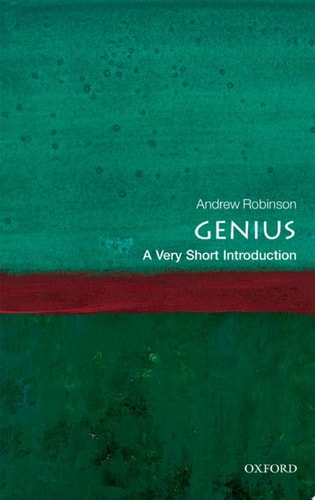
Genius: A Very Short Introduction
0
0
As an Amazon Associate and affiliate partner, Menrva Books earns from qualifying purchases. Learn more
Author Description
Homer, Leonardo da Vinci, Mozart, Shakespeare, and Tolstoy; Curie, Darwin, Einstein, Galileo, and Newton. What do these world-famous artists and scientists have in common?- apart from the fact that their achievements predate our own time by a century or more. Most of us would probably answer: all ten possessed something we call genius, which in each instance permanently changed the way that humanity perceived the world. But pressed to be more precise, we find it remarkably hard to define genius. Genius is highly individual and unique, of course, yet it shares a compelling, inevitable quality for professionals and the general public alike. Darwin's ideas are still required reading for every working biologist; they continue to generate fresh thinking and experiments around the world. So do Einstein's theories among physicists. Shakespeare's plays and Mozart's melodies and harmonies continue to move people in languages and cultures far removed from their native England and Austria. Contemporary 'geniuses' may come and go, but the idea of genius will not let go of us. Genius is the name we give to a quality of work that transcends fashion, celebrity, fame, and reputation: the opposite of a period piece. Somehow, genius abolishes both the time and the place of its origin. This Very Short Introduction uses the life and work of familiar geniuses-and some less familiar-to illuminate both the individual and the general aspects of genius. In particular: the roles of talent, heredity, parenting, education, training, hard work, intelligence, personality, mental illness, inspiration, eureka moments, and luck, in the making of genius. ABOUT THE SERIES: The Very Short Introductions series from Oxford University Press contains hundreds of titles in almost every subject area. These pocket-sized books are the perfect way to get ahead in a new subject quickly. Our expert authors combine facts, analysis, perspective, new ideas, and enthusiasm to make interesting and challenging topics
Menrva's Summary
THE THESIS
What defines the elusive quality of genius, and how does it manifest across diverse fields of human achievement? Andrew Robinson, an experienced writer and editor, examines the intersection of individual talent and societal impact by analyzing the lives of historical figures ranging from Leonardo da Vinci to Albert Einstein. He constructs a framework that evaluates the interplay between innate ability, environmental factors, and the enduring nature of work that transcends its original historical context.
THE SCOPE MAP
What You Will Find
- Comparative analysis of historical figures in arts and sciences
- Examination of factors such as heredity, education, and personality
- Discussion on the role of 'eureka' moments and inspiration
Scope Limits
- Does not provide a definitive, singular psychological definition of genius
- Focuses primarily on historical examples rather than contemporary psychological testing
THE AUTHORITY PERSPECTIVE
This text is recognized as a concise, accessible entry point for those interested in the history of intellectual achievement. Readers frequently note that the prose is highly readable while maintaining the academic rigor expected of the Oxford University Press series.
Page Count:
153
Publication Date:
2011-01-01
Publisher:
OUP Oxford
ISBN-10:
0191611441
ISBN-13:
9780191611445
Biography
Psychology
Non-Fiction
Philosophy
Science
Intellectual History
Community Tags
Other Editions(2)
Similar Books


Reader Comments
Share Your Thoughts
No comments yet. Be the first to share your thoughts!