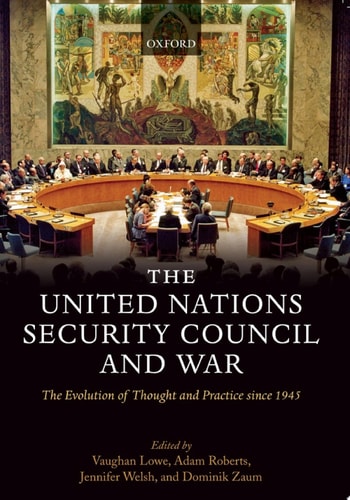
The United Nations Security Council and War: The Evolution of Thought and Practice since 1945
0
0
As an Amazon Associate and affiliate partner, Menrva Books earns from qualifying purchases. Learn more
Author Description
This is the first major exploration of the United Nations Security Council's part in addressing the problem of war, both civil and international, since 1945. Both during and after the Cold War the Council has acted in a limited and selective manner, and its work has sometimes resulted in failure. It has not been - and was never equipped to be - the centre of a comprehensive system of collective security. However, it remains the body charged with primary responsibility for international peace and security. It offers unique opportunities for international consultation and military collaboration, and for developing legal and normative frameworks. It has played a part in the reduction in the incidence of international war in the period since 1945. This study examines the extent to which the work of the UN Security Council, as it has evolved, has or has not replaced older systems of power politics and practices regarding the use of force. Its starting point is the failure to implement the UN Charter scheme of having combat forces under direct UN command. Instead, the Council has advanced the use of international peacekeeping forces; it has authorized coalitions of states to take military action; and it has developed some unanticipated roles such as the establishment of post-conflict transitional administrations, international criminal tribunals, and anti-terrorism committees. The book, bringing together distinguished scholars and practitioners, draws on the methods of the lawyer, the historian, the student of international relations, and the practitioner. It begins with an introductory overview of the Council's evolving roles and responsibilities. It then discusses specific thematic issues, and through a wide range of case studies examines the scope and limitations of the Council's involvement in war. It offers frank accounts of how belligerents viewed the UN, and how the Council acted and sometimes failed to act. The appendices provide comprehensive information - much o
Menrva's Summary
THE THESIS
This work investigates the evolution of the United Nations Security Council's role in managing international and civil conflict from 1945 to the present. The authors, a team of distinguished scholars and practitioners, analyze the gap between the original UN Charter mandate for collective security and the Council's actual operational history. By synthesizing legal, historical, and political perspectives, the text evaluates how the Council has navigated power politics while developing new mechanisms for peacekeeping, transitional administration, and international justice.
THE SCOPE MAP
What You Will Find
- Historical analysis of the Security Council's actions during and after the Cold War.
- Examination of the shift from direct UN-commanded forces to authorized coalitions and peacekeeping missions.
- Case studies detailing specific interventions and instances of institutional failure.
- Appendices containing comprehensive data on Council resolutions and operational history.
Scope Limits
- The text does not provide a prescriptive manual for future UN reform.
- It does not cover the internal administrative minutiae of the UN Secretariat beyond their impact on security operations.
THE AUTHORITY PERSPECTIVE
Experts recognize this volume as a foundational interdisciplinary study that bridges the gap between legal theory and political practice. Readers frequently note the academic density of the prose, which makes it a standard reference for students and professionals in international relations.
Page Count:
817
Publication Date:
2010-01-01
Publisher:
OUP Oxford
ISBN-10:
0191614939
ISBN-13:
9780191614934
History
International relations
United Nations
International Security
International Law
War Studies
Community Tags
Similar Books

Reader Comments
Share Your Thoughts
No comments yet. Be the first to share your thoughts!