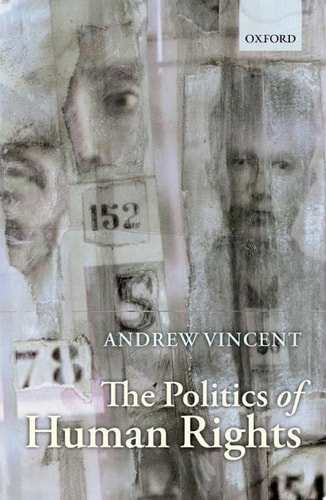
The Politics of Human Rights
0
0
As an Amazon Associate and affiliate partner, Menrva Books earns from qualifying purchases. Learn more
Author Description
The Politics of Human Rights provides a systematic introductory overview of the nature and development of human rights. At the same time it offers an engaging argument about human rights and their relationship with politics. The author argues that human rights have only a slight relation to natural rights and they are historically novel: In large part they are a post-1945 reaction to genocide which is, in turn, linked directly to the lethal potentialities of the nation-state. He suggests that an understanding of human rights should nonetheless focus primarily on politics and that there are no universally agreed moral or religious standards to uphold them, they exist rather in the context of social recognition within a political association. A consequence of this is that the 1948 Universal Declaration is a political, not a legal or moral, document. Vincent goes on to show that human rights are essentially reliant upon the self-limitation capacity of the civil state. With the development of this state, certain standards of civil behaviour have become, for a sector of humanity, slowly and painfully more customary. He shows that these standards of civility have extended to a broader society of states. At their best human rights are an ideal civil state vocabulary. The author explains that we comprehend both our own humanity and human rights through our recognition relations with other humans, principally via citizenship of a civil state. Vincent concludes that the paradox of human rights is that they are upheld, to a degree, by the civil state, but the point of such rights is to protect against another dimension of this same tradition (the nation-state). Human rights are essentially part of a struggle at the core of the state tradition.
Menrva's Summary
THE THESIS
This book investigates the core question of whether human rights are fundamentally moral, legal, or political constructs within the modern state system. Andrew Vincent, a scholar of political theory, utilizes historical analysis and political philosophy to argue that human rights are a post-1945 reaction to the dangers of the nation-state. He posits that these rights lack universal moral foundations and instead rely on the self-limitation of the civil state and social recognition within political associations.
THE SCOPE MAP
What You Will Find
- Historical analysis of the post-1945 international order.
- A critique of the 1948 Universal Declaration of Human Rights as a political document.
- Examination of the tension between the civil state and the nation-state.
- Theoretical framework regarding recognition relations and citizenship.
Scope Limits
- The text does not provide a comprehensive legal manual for human rights litigation.
- It avoids theological or purely religious justifications for human rights.
THE AUTHORITY PERSPECTIVE
Scholars and students of political theory frequently note the academic density and rigorous argumentative structure of the prose. Experts highlight this work as a significant contribution to understanding the political origins of human rights rather than viewing them as abstract moral imperatives.
Page Count:
271
Publication Date:
2010-01-01
Publisher:
OUP Oxford
ISBN-10:
0191613703
ISBN-13:
9780191613708
Philosophy
History
Human rights
International relations