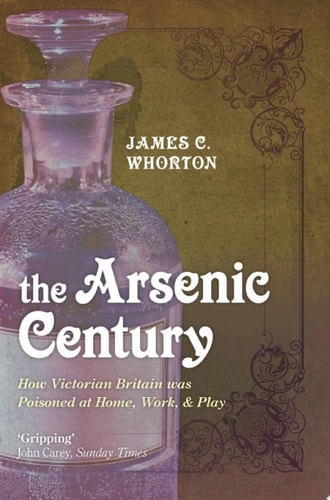
The Arsenic Century: How Victorian Britain was Poisoned at Home, Work, and Play
0
0
As an Amazon Associate and affiliate partner, Menrva Books earns from qualifying purchases. Learn more
Author Description
Arsenic is rightly infamous as the poison of choice for Victorian murderers. Yet the great majority of fatalities from arsenic in the nineteenth century came not from intentional poisoning, but from accident. Kept in many homes for the purpose of poisoning rats, the white powder was easily mistaken for sugar or flour and often incorporated into the family dinner. It was also widely present in green dyes, used to tint everything from candles and candies to curtains, wallpaper, and clothing (it was arsenic in old lace that was the danger). Whether at home amidst arsenical curtains and wallpapers, at work manufacturing these products, or at play swirling about the papered, curtained ballroom in arsenical gowns and gloves, no one was beyond the poison's reach. Drawing on the medical, legal, and popular literature of the time, The Arsenic Century paints a vivid picture of its wide-ranging and insidious presence in Victorian daily life, weaving together the history of its emergence as a nearly inescapable household hazard with the sordid story of its frequent employment as a tool of murder and suicide. And ultimately, as the final chapter suggests, arsenic in Victorian Britain was very much the pilot episode for a series of environmental poisoning dramas that grew ever more common during the twentieth century and still has no end in sight.
Menrva's Summary
THE THESIS
This book investigates how the widespread, often accidental, presence of arsenic permeated every facet of Victorian British life, transforming a common household substance into a pervasive environmental hazard. James C. Whorton, a historian of medicine and science, utilizes a vast array of medical journals, legal records, and popular literature from the nineteenth century to construct his argument. He posits that the ubiquity of arsenic in consumer goods, from wallpaper to food, created a public health crisis that foreshadowed modern environmental contamination issues.
THE SCOPE MAP
What You Will Find
- Analysis of arsenic usage in Victorian domestic products, including dyes, wallpaper, and food additives.
- Examination of the medical and legal responses to accidental and intentional arsenic poisoning.
- Historical context regarding the industrial manufacturing processes that introduced arsenic into the home.
Scope Limits
- The text focuses primarily on the British experience during the nineteenth century.
- It does not provide a comprehensive global history of arsenic usage beyond the Victorian context.
THE AUTHORITY PERSPECTIVE
Experts and historians frequently cite this work as a definitive study on the intersection of Victorian consumer culture and public health. Readers often note the meticulous research and the accessible prose that makes complex toxicological history engaging for a general audience.
Page Count:
436
Publication Date:
2010-01-01
Publisher:
OUP Oxford
ISBN-10:
0191623431
ISBN-13:
9780191623431
History
Environmental History
Medicine
Arsenic
Great Britain
Toxicology
Victorian Era
European History
Social History
Community Tags
Similar Books