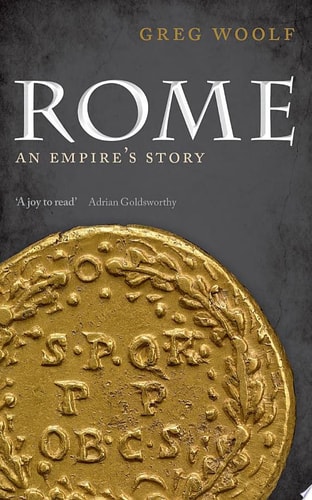
Rome: An Empire's Story
0
0
As an Amazon Associate and affiliate partner, Menrva Books earns from qualifying purchases. Learn more
Author Description
The idea of empire was created in ancient Rome and even today the Roman empire offers a powerful image for thinking about imperialism. Traces of its monuments and literature can be found across Europe, the Near East, and North Africa - and sometimes even further afield. This is the story of how this mammoth empire was created, how it was sustained in crisis, and how it shaped the world of its rulers and subjects - a story spanning a millennium and a half. Chapters that tell the story of the unfolding of Rome's empire alternate with discussions based on the most recent evidence into the conditions that made the Roman imperial achievement possible and also so durable, covering topics as diverse as ecology, slavery, and the cult paid to gods and men. Rome was not the only ancient empire. Comparison with other imperial projects helps us see what it was that was so distinctive about ancient Rome. Ancient Rome has also often been an explicit model for other imperialisms. Rome, An Empire's Story shows quite how different Roman imperialism was from modern imitations. The story that emerges outlines the advantages of Rome had over its neighbours at different periods - some planned, some quite accidental - and the stages by which Rome's rulers successively had to change the way they ruled to cope with the problems of growth. As Greg Woolf demonstrates, nobody ever planned to create a state that would last more than a millennium and a half, yet the short term politics of alliances between successively wider groups created a structure of extraordinary stability. Rome's Empire was able, in the end, to survive barbarian migrations, economic collapse and even the conflicts between a series of world religions that had grown up within it, in the process generating an imagery and a myth of empire that is apparently indestructible.
Menrva's Summary
THE THESIS
How did the Roman Empire manage to sustain itself for over a millennium and a half while shaping the political and cultural landscape of the ancient world? Greg Woolf, a distinguished historian of the ancient world, utilizes archaeological evidence, literary sources, and comparative analysis to examine the mechanisms of Roman expansion and durability. He argues that the empire was not the result of a singular grand design, but rather the product of evolving political alliances and adaptive governance in response to successive crises. The text provides a comprehensive framework for understanding how Rome navigated ecological challenges, economic shifts, and religious transformations to maintain its structural integrity.
THE SCOPE MAP
What You Will Find
- A chronological narrative of Roman expansion spanning fifteen centuries.
- Comparative analysis between Roman imperialism and other ancient imperial projects.
- Thematic investigations into ecology, slavery, and the cult of personality.
- Examination of the administrative adaptations required to manage territorial growth.
Scope Limits
- The text does not provide an exhaustive military history of every Roman campaign.
- It does not focus on the internal biographies of individual emperors, prioritizing systemic and structural analysis over personal narrative.
THE AUTHORITY PERSPECTIVE
Scholars and readers frequently note the accessibility of Woolf's prose, which manages to synthesize complex historical data without sacrificing academic rigor. Experts highlight this work as a balanced, modern overview that effectively distinguishes Roman imperial practices from later, modern imitations.
Page Count:
378
Publication Date:
2012-01-01
Publisher:
OUP Oxford
ISBN-10:
0191626864
ISBN-13:
9780191626869
History
European History
Ancient History
Europe
Imperialism
Kindle eBooks
Italy history
Roman Empire
Rome
Categories
Kindle Store
Community Tags
Other Editions(3)
Similar Books

Reader Comments
Share Your Thoughts
No comments yet. Be the first to share your thoughts!