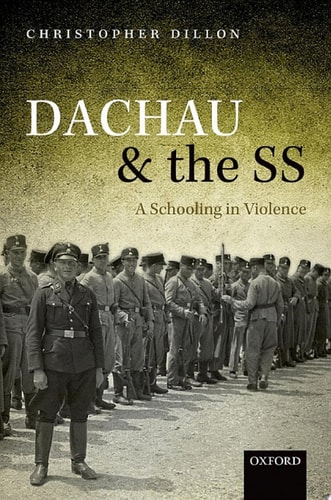
Dachau and the SS: A Schooling in Violence
0
0
As an Amazon Associate and affiliate partner, Menrva Books earns from qualifying purchases. Learn more
Author Description
Dachau and the SS studies the concentration camp guards at Dachau, the first SS concentration camp and a national 'school' of violence for its concentration camp personnel. Set up in the first months of Adolf Hitler's rule, Dachau was a bastion of the Nazi 'revolution' and a key springboard for the ascent of Heinrich Himmler and the SS to control of the Third Reich's terror and policing apparatus. Throughout the pre-war era of Nazi Germany, Dachau functioned as an academy of violence where concentration camp personnel were schooled in steely resolution and the techniques of terror. An international symbol of Nazi depredation, Dachau was the cradle of a new and terrible spirit of destruction. Combining extensive new research into the pre-war history of Dachau with theoretical insights from studies of perpetrator violence, this book offers the first systematic study of the 'Dachau School'. It explores the backgrounds and socialization of thousands of often very young SS men in the camp and critiques the assumption that violence was an outcome of personal or ideological pathologies. Christopher Dillon analyses recruitment to the Dachau SS and evaluates the contribution of ideology, training, social psychology and masculine ideals to the conduct and subsequent careers of concentration camp guards. Graduates of the Dachau School would go on to play a central role in the wartime criminality of the Third Reich, particularly at Auschwitz. Dachau and the SS makes an original contribution to scholarship on the pre-history of the Holocaust and the institutional organisation of violence.
Menrva's Summary
THE THESIS
This book investigates how the Dachau concentration camp functioned as an institutional training ground for SS personnel, shaping the violent practices that would later define the Third Reich's terror apparatus. Christopher Dillon, a historian specializing in the Nazi era, utilizes extensive archival research and theoretical frameworks from perpetrator studies to challenge the notion that camp violence was merely the result of individual pathology. Instead, he argues that the 'Dachau School' systematically socialized young men through a combination of ideological indoctrination, masculine ideals, and specific training techniques. By examining the recruitment and career trajectories of these guards, the author provides a structural analysis of how institutional environments facilitate the normalization of extreme violence.
THE SCOPE MAP
What You Will Find
- Analysis of the pre-war history of the Dachau concentration camp.
- Examination of SS recruitment, training, and socialization processes.
- Application of social psychology and theories of perpetrator violence.
- Evaluation of the career paths of camp guards who later served at Auschwitz.
Scope Limits
- The study focuses primarily on the pre-war era of Nazi Germany.
- It does not provide a comprehensive history of the Holocaust as a whole, but rather focuses on the institutional origins of its perpetrators.
THE AUTHORITY PERSPECTIVE
Scholars recognize this work as a significant contribution to the institutional history of the SS and the pre-history of the Holocaust. Experts frequently highlight the book's success in moving beyond individual psychological profiles to provide a rigorous, systemic analysis of how violence is cultivated within state organizations.
Page Count:
281
Publication Date:
2016-01-01
Publisher:
OUP Oxford
ISBN-10:
0192513346
ISBN-13:
9780192513342
History
Kindle Store
Military History
Nazi Germany
Europe
Kindle eBooks
Waffen-ss
Categories
Germany
European History
Community Tags
Similar Books