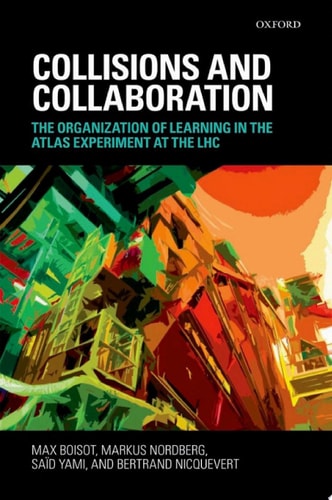
Collisions and Collaboration: The Organization of Learning in the ATLAS Experiment at the LHC
0
0
As an Amazon Associate and affiliate partner, Menrva Books earns from qualifying purchases. Learn more
Author Description
After twenty-five years of preparation, the Large Hadron Collider at CERN, Geneva, is finally running its intensive scientific experiments into high-energy particle physics. These experiments, which have so captured the public's imagination, take the world of physics to a new energy level, the terascale, at which elementary particles are accelerated to one millionth of a percent of the speed of light and made to smash into each other with a combined energy of around fourteen trillion electron-volts. What new world opens up at the terascale? No one really knows, but the confident expectation is that radically new phenomena will come into view. The kind of 'big science' being pursued at CERN, however, is becoming ever more uncertain and costly. Do the anticipated benefits justify the efforts and the costs? This book aims to give a broad organizational and strategic understanding of the nature of 'big science' by analyzing one of the major experiments that uses the Large Hadron Collider, the ATLAS Collaboration. It examines such issues as: the flow of 'interlaced' knowledge between specialist teams; the intra- and inter-organizational dynamics of 'big science'; the new knowledge capital being created for the workings of the experiment by individual researchers, suppliers, and e-science and ICTs; the leadership implications of a collaboration of nearly three thousand members; and the benefits for the wider societal setting. This book aims to examine how, in the face of high levels of uncertainty and risk, ambitious scientific aims can be achieved by complex organizational networks characterized by cultural diversity, informality, and trust - and where 'big science' can head next.
Menrva's Summary
THE THESIS
How can massive, high-risk scientific collaborations maintain operational efficacy and innovation within complex, decentralized organizational networks? The authors, a multidisciplinary team of researchers and organizational experts, utilize the ATLAS experiment at CERN as a primary case study to investigate the intersection of high-energy physics and large-scale project management. They argue that the success of 'big science' relies on specific mechanisms of knowledge exchange, trust-based cooperation, and the integration of diverse professional cultures across global boundaries.
THE SCOPE MAP
What You Will Find
- Analysis of the ATLAS Collaboration as a model for large-scale organizational networks.
- Examination of knowledge flow between specialized research teams and external suppliers.
- Discussion of leadership strategies required for managing thousands of international members.
- Evaluation of the role of e-science and ICT infrastructure in sustaining scientific progress.
Scope Limits
- The text does not provide a technical manual for particle physics experiments.
- It does not offer a comprehensive history of CERN beyond the context of the ATLAS project.
THE AUTHORITY PERSPECTIVE
Experts in organizational studies and science policy identify this work as a significant contribution to understanding the management of extreme-scale scientific endeavors. Readers frequently note the academic density of the prose, which serves as a rigorous examination of institutional dynamics rather than a general-interest overview.
Page Count:
336
Publication Date:
2011-01-01
Publisher:
OUP Oxford
ISBN-10:
0191620378
ISBN-13:
9780191620379
Science
Nuclear Physics
Experiments
Earth Sciences
Organizational Theory
Physics
Organizational effectiveness
Big Science
Management
Sociology of Science
Evaluation
Community Tags
Other Editions(2)

Similar Books



Reader Comments
Share Your Thoughts
No comments yet. Be the first to share your thoughts!