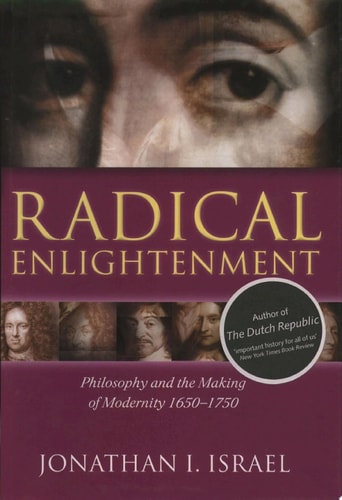
Radical Enlightenment: Philosophy and the Making of Modernity 1650-1750
0
0
As an Amazon Associate and affiliate partner, Menrva Books earns from qualifying purchases. Learn more
Author Description
Arguably the most decisive shift in the history of ideas in modern times was the complete demolition during the late seventeenth and eighteenth centuries - in the wake of the Scientific Revolution - of traditional structures of authority, scientific thought, and belief by the new philosophy and the philosophes, culminating in Voltaire, Diderot, and Rousseau. In this revolutionary process which effectively overthrew all justicfication for monarchy, aristocracy, and ecclesiastical power, as well as man's dominance over woman, theological dominance of education, and slavery, substituting the modern principles of equality, democracy, and universality, the Radical Enlightenment played a crucially important part. Despite the present day interest in the revolutions of the late eighteenth century, the origins and rise of the Radical Enlightenment have been astonishingly little studied doubtless largely because of its very wide international sweep and the obvious difficulty of fitting in into the restrictive conventions of 'national history' which until recently tended to dominate all historiography. The greatest obstacle to the Radical Enlightenment finding its proper place in modern historical writing is simply that it was not French, British, German, Italian, Jewish or Dutch, but all of these at the same time. In this novel interpretation of the Radical Enlightenment down to La Mettie and Diderot, two of its key exponents, particular stress is placed on the pivotal role of Spinoza and the widespread underground international philosophical movement known before 1750 as Spinozism.
Menrva's Summary
THE THESIS
This work investigates how the Radical Enlightenment, driven by the philosophy of Spinoza, dismantled traditional structures of authority and laid the foundation for modern democratic principles between 1650 and 1750. Professor Jonathan I. Israel, a specialist in early modern European history, utilizes a vast array of international primary sources to argue that the shift toward equality and secularism was a pan-European phenomenon rather than a product of any single nation. He posits that the underground movement known as Spinozism provided the intellectual framework necessary to challenge monarchy, ecclesiastical power, and social hierarchies.
THE SCOPE MAP
What You Will Find
- An analysis of the intellectual transition from the Scientific Revolution to the Enlightenment.
- A detailed examination of Spinoza's influence on 18th-century thinkers like Diderot and La Mettrie.
- A comparative study of philosophical developments across Dutch, British, French, and German contexts.
Scope Limits
- The analysis concludes around 1750 and does not extensively cover the later political revolutions of the late 18th century.
- The text focuses primarily on high-level philosophical discourse rather than the socio-economic conditions of the broader populace.
THE AUTHORITY PERSPECTIVE
Scholars frequently cite this work as a significant re-evaluation of the Enlightenment, noting its ambitious scope and dense, rigorous academic prose. It is widely regarded as a foundational text for understanding the intellectual origins of modern secular and democratic thought.
Page Count:
833
Publication Date:
2002-01-01
Publisher:
OUP Oxford
ISBN-10:
0191622877
ISBN-13:
9780191622878
History
Philosophy
Political Theory
European History
Intellectual History
Enlightenment
Community Tags
Similar Books