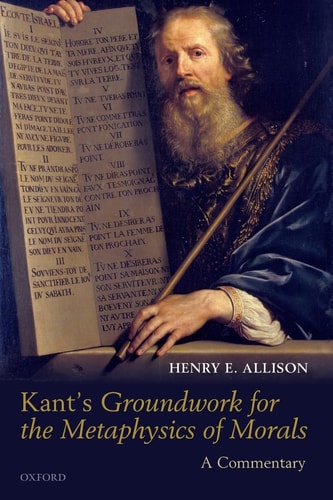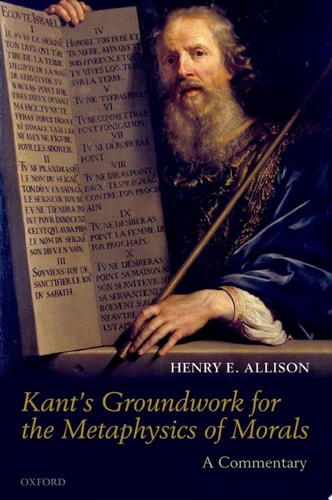
Kant's Groundwork for the Metaphysics of Morals: A Commentary
0
0
As an Amazon Associate and affiliate partner, Menrva Books earns from qualifying purchases. Learn more
Author Description
Henry E. Allison presents a comprehensive commentary on Kant's Groundwork for the Metaphysics of Morals (1785). It differs from most recent commentaries in paying special attention to the structure of the work, the historical context in which it was written, and the views to which Kant was responding. Allison argues that, despite its relative brevity, the Groundwork is the single most important work in modern moral philosophy and that its significance lies mainly in two closely related factors. The first is that it is here that Kant first articulates his revolutionary principle of the autonomy of the will, that is, the paradoxical thesis that moral requirements (duties) are self-imposed and that it is only in virtue of this that they can be unconditionally binding. The second is that for Kant all other moral theories are united by the assumption that the ground of moral requirements must be located in some object of the will (the good) rather than the will itself, which Kant terms heteronomy. Accordingly, what from the standpoint of previous moral theories was seen as a fundamental conflict between various views of the good is reconceived by Kant as a family quarrel between various forms of heteronomy, none of which are capable of accounting for the unconditionally binding nature of morality. Allison goes on to argue that Kant expresses this incapacity by claiming that the various forms of heteronomy unavoidably reduce the categorical to a merely hypothetical imperative.
Menrva's Summary
THE THESIS
This commentary investigates the structural and historical foundations of Immanuel Kant's Groundwork for the Metaphysics of Morals to clarify his argument for the autonomy of the will. Henry E. Allison, a scholar of Kantian philosophy, utilizes historical context and textual analysis to argue that the Groundwork serves as the primary text in modern moral philosophy. He posits that Kant's distinction between autonomy and heteronomy is the central mechanism for understanding why moral duties must be self-imposed to remain unconditionally binding.
THE SCOPE MAP
What You Will Find
- Detailed structural analysis of Kant's 1785 text
- Historical context regarding the philosophical views Kant addressed
- Examination of the categorical versus hypothetical imperative
- Argumentation regarding the failure of heteronomous moral theories
Scope Limits
- Does not provide a general introduction to Kant's entire philosophical system
- Does not focus on Kant's later political or aesthetic writings
THE AUTHORITY PERSPECTIVE
Scholars and students of philosophy frequently identify this text as a rigorous and essential resource for navigating the complexities of Kantian ethics. Experts highlight Allison's ability to synthesize historical background with dense logical arguments, making it a standard reference for advanced study of the Groundwork.
Page Count:
389
Publication Date:
2011-01-01
Publisher:
OUP Oxford
ISBN-10:
0191620599
ISBN-13:
9780191620591
Philosophy
Academic Commentary
Ethics
Kant
Moral Philosophy